
Twitch AI Training, Colorado’s AI Therapy Law, and the Pixel 11
Dear Friend,
In our AI Smart Lab session last week, we built out our ClickUp agents. Instead of running one general assistant, we started grouping agents by the services a client actually buys, so each account has its own small set of agents that knows that client’s work.
What made it click was handing the agents real, repeating jobs: scheduled follow-ups, task creation, and the assistant work that used to wait on a person. Give an agent one clear job and it holds it. Give it a vague one and it drifts.
Microsoft Copilot Without the Learning Curve
If you are paying for Copilot licenses your team barely opens, this one is for you. The post breaks down what Copilot actually does inside Outlook, Teams, and Word, why rollouts stall after month two, and how to run a tight 30-day pilot with one team and one number to beat. It also covers the access review most companies skip, since Copilot will happily summarize any file, your share settings may be left open to everyone.

Our Most Requested Service: AI Strategy and Consulting
Clients keep coming to us with the same question. They know AI can help, but which tools to trust, how to protect their data, and how to bring the team along feels like a lot to figure out alone.
We start with your goals, your data, your staffing, and the tools you already pay for, then build a safe, simple, phased roadmap your team can actually follow. In a recent strategy, that first pass found 125 to 185 hours of administrative work a month the client could recover through the initial automation phase alone.
That is the kind of number that changes a budget conversation. Book a meeting today
This week’s stories
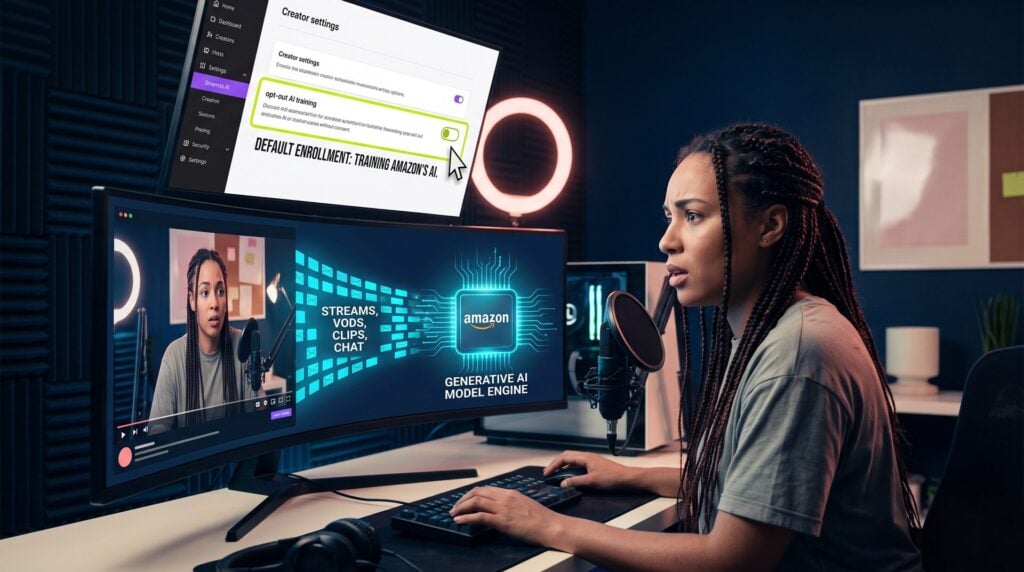
Twitch Will Train Amazon’s AI on Your Streams Unless You Say No
Twitch added a setting that lets streamers opt out of having their content train Amazon’s generative AI models. Everyone is opted in by default, and the setting covers streams, VODs, clips, and chat. The backlash was immediate, with thousands of creators demanding the platform ask permission first. The opt-out only covers future training, and Twitch has not said how much content Amazon already used.
My Take: Twitch admitted f it were opt-in, nobody would opt in. That tells you exactly how much platforms now value unscripted human video, and it means every platform you publish on will try the same move within a year. We keep our finished content in documents and drives we control, not only inside the platforms that display it, because the platform’s copy of your work was never really yours. I would go flip that toggle today, then ask what else you post that carries the same default.
Source: Twitch Support on X
Colorado’s New Law Says AI Cannot Be Your Therapist
Colorado’s psychotherapy AI law took effect on August 12. AI can still handle scheduling, billing, and notes, but it cannot deliver therapy, make its own treatment recommendations, or read a client’s emotional state without a licensed professional in the loop. Recording or transcribing a session with AI now requires written consent.
In plain terms, if a chatbot presents itself as equal to a licensed therapist, or implies the conversation is confidential like real therapy, that is now a deceptive trade practice the state can act on.
My Take: This is the template other states will copy, because it regulates the use case instead of the model, and use-case rules survive both elections and model releases. When we build a roadmap for a client, which tools to trust and how to protect data are the first questions on the table, and laws like this are exactly why. If your product has a chatbot that even sounds like emotional support, read what it says about itself this week, before a regulator does.
Source: Colorado General Assembly

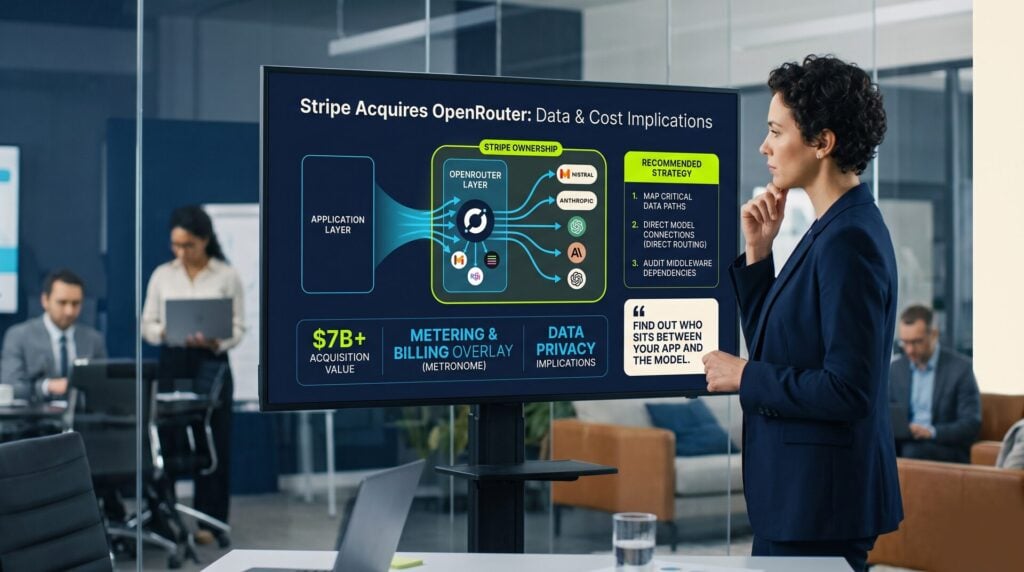
Stripe Buys OpenRouter, the Layer That Lets Apps Switch AI Models
Stripe, the payments company, agreed to buy OpenRouter for more than $7 billion. OpenRouter is the gateway about 8 million developers use to reach more than 400 AI models through one connection, picking the cheapest or best model for each task. The price is roughly five times what OpenRouter was worth three months ago. Stripe now sits between apps and the AI models they run on, seeing which models get used and taking a cut.
My Take: OpenRouter sold itself as the neutral middle, the way to use any model and stay free of a single vendor. That neutral middle just got an owner, and the owner is a payments company that already meters AI usage through its Metronome deal. So the layer built to keep you unlocked now answers to one company that can see what you run and bill for the routing. We use Open Router and still send our most important work to models we pick directly, because a middle layer is one more place that can see your data, raise its prices, or go down. Find out exactly who sits between your app and the model before you route everything through them.
Source: Bloomberg
One Poisoned AI Package Reached 2,500 Companies in 40 Minutes
Security firm CloudSEK disclosed that a March attack on LiteLLM, an open-source tool that connects apps to AI models, may have exposed more than 2,500 organizations and about 434,000 software pipelines. The malicious versions were live for only 40 minutes. The FBI warns the stolen credentials can still be weaponized months later.
My Take: Forty minutes of exposure, months of risk, and most of the affected companies never chose LiteLLM at all. It rode in as a dependency inside something else they use. The AI boom made everyone’s software supply chain deeper and stranger, and you cannot secure an inventory you have never written down. In our AI Smart Lab session this week we audited every subscription, connector, integration we run and gave each one an owner, and changed usernames and passwords. That list is not just a cost exercise. It is the map of everything an attacker can reach.
Source: CloudSEK

A $250 Million AI Acquisition Unravels Into Fraud Claims
VideoVerse, an AI sports-clipping startup, sold to publisher Minute Media for $250 million last year. Now investors say they were never paid, a lender says $53 million was wired against forged documents and fake bank screenshots, and the founder faces multiple suits in Delaware. Minute Media has walked away from the deal.
My Take: The diligence failure here was not technical. It was human. A hot AI deal moved on trust, a known acquirer’s name, and screenshots nobody verified at the source. As AI valuations keep outrunning verification, expect more of these stories, not fewer. When we take on a client, we build from their real numbers: goals, data, staffing, and the tools they already run. I would hold any AI company you buy from, invest in, or depend on to the same rule: verify the numbers with the customers and the bank, never with the founder’s screenshots or lofty ideal.
Source: TechCrunch

Tool picks of the week
HeyGen: Create studio-quality videos with lifelike avatars and voices for marketing and social media. In a week where platforms are training on creator video by default, making your own branded video on your own terms is worth more.
OpusClip: Turn long-form video into short clips for social media. If your long recordings are feeding someone else’s AI anyway, at least squeeze your own value out of them first.
AI Use Policy: AI Smart’s own AI Use Policy, free to reference or adapt. After a week of default opt-ins and supply chain surprises, a written policy on which tools touch your data is the cheapest protection there is.
Got a burning question, a fresh take, or just want to share your latest AI wins? Hit us up at [email protected]. Your insights keep this community growing and thriving!
Have a great day!
-Nicole A. Donnelly
Founder, AI Smart Ventures
AI Strategy – AI Training – AI Consulting – AI Implementation