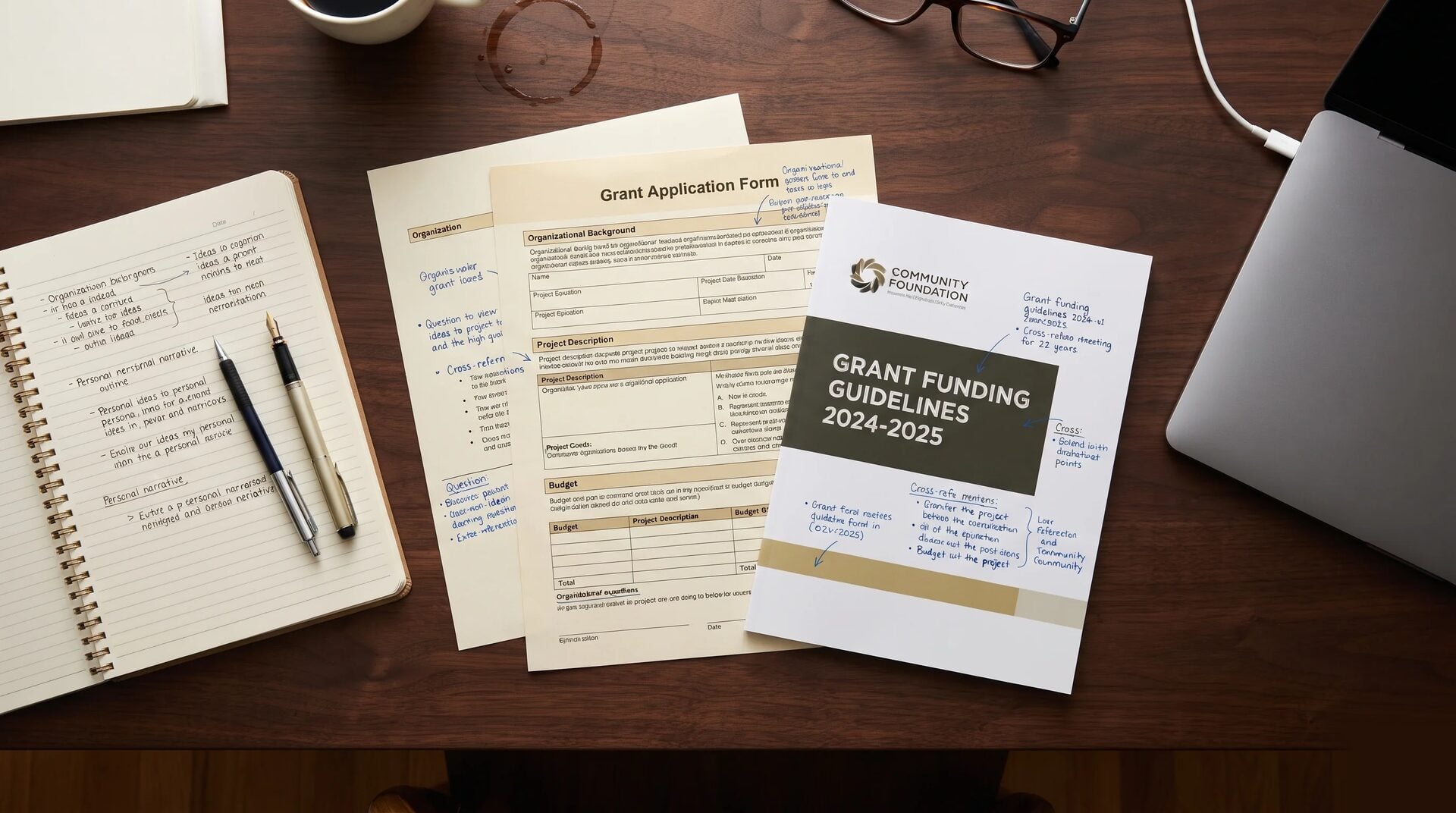
Can AI Write a Grant Application in Your Own Voice?
Last Updated: October 2026
AI grant writing is the use of an AI tool to help build a funding application: pulling text out of files you already have, fitting it to a funder’s form, and spotting what is missing. It does that part well. What it cannot do is say why a funder should back your group rather than the twenty others who answer the same question that week.
AI Smart Ventures has guided growing businesses and nonprofits through AI adoption on the papers they send out, grant forms among them. The pattern holds across funders. Drafts come back clean, correct and oddly familiar, because the part meant to stand out was written by the tool everybody else used.
That sameness loses you the one thing a funder is looking for. A reader working through a stack of forms wants a reason to pick you. Hand them a tidy page that could belong to anyone, and you have given them no reason at all.
Key Takeaways
- Readers look for difference: a form that answers every question in the funder’s own words still loses if nothing in it could only be true of your group.
- AI flattens style, not facts: a study revised in August 2026 across seven data sets and more than 880,000 texts found AI writing tools cut the spread in how complex writing is by 21% to 50%.
- AI checks rules, it does not judge: a March 2026 study of AI grant review rated its feedback mostly sound, yet tilted toward rule checking over a view of the whole file.
- Each funder’s own rules govern: NSF asks those who apply to say how AI was used, many private funders say nothing, and silence is not a yes.
Read the second and third points together and the split writes itself. A tool that smooths style and checks rules belongs on the half of a grant form that is rules. It is the wrong tool for the half that has to win over a person.
Can AI write a grant application in your voice?
Not the half that decides anything. AI can copy the surface of how your group writes: sentence length, favorite words, the way you name your programs. What it cannot supply is the part underneath, which is what you have seen in the work and why you think this project will hold. Feed it a dozen past forms and you get your register back, cleanly. The case still comes from someone who ran the program.
Voice, in a grant form, is really evidence. Readers are not scoring prose, and they rarely recall a cadence. The line that lands is nearly always a fact nobody else could write: the two sites you closed and what that taught you, the month your waiting list stopped moving, the intake question you dropped. No tool reaches any of that unless a person puts it there, which is what human-first AI means here.
Why do AI grant forms blur together for a reader?
Because the same few models write in the same register, and funders ask everyone the same questions. The study revised in August 2026 found that AI writing tools hold the content of a text steady while making its style far more alike. The spread in how complex the writing is fell by 21% to 50%. Meaning survives the edit. What goes is the gap between one writer and the next, and that gap is what a reader sorting a stack uses.
Funder forms pull the same way. A question phrased as “describe the community need and your capacity to meet it” invites a version of itself, and AI is good at that. So drafts end up alike twice over, once through the model and once through the question. The risk is not that a reader catches you out. It is that nothing in your file gives them a case to argue for in the room where the choice gets made.
Which parts of the grant form must be yours?
Four parts, and they are the ones with judgment in them: why your group is the right one, what you have seen in the work, what you will do differently from last year, and what you will count as success. Each rests on what people know, not on what sits in a file. Write those yourself, in plain lines, before any tool touches the page. The rest can be put together.

The pull runs the other way, because those four are the hard parts and a blank page is no fun. A draft lands in two minutes, reads fine, and stands in for thinking you had not done. AI Smart Ventures observes that the sections leaders feel least sure about are the ones they hand over first, which is the wrong order. Write the shaky parts badly by hand, then let a tool tidy them.
| Part of the form | Who writes it |
|---|---|
| Why your group | Your team, from the record |
| What you have seen | Your team, with places and dates |
| What changes this year | Your team, then AI for the cut |
| Background and history | AI first pass, staff check |
| Layout and word limits | AI, every time |
| Budget narrative wording | Finance lead, AI for consistency |
What does AI really do well on a grant form?
The routine work, and there is plenty of it. It turns text you already hold into the funder’s shape, holds a section to its word limit, keeps terms the same across twelve pages written by four people, and names the question you left open. That last job is where tools are strongest and teams weakest. A March 2026 study of AI grant review tested three setups on proposals seeded with planted faults, and section-by-section checking caught the most.
The same study is a warning about where to stop. Its human check rated the AI feedback mostly sound, but leaning toward rule checking rather than a view of the proposal as a whole. Faults in clarity slipped past every setup tested. That is a fair sketch of the right job for the tool. Tool-first AI agencies tend to sell the whole document; the useful version is narrower, and it is practical AI aimed at the parts with rules.
- Turn old text into the new shape: give it last year’s form and this funder’s question list, then have it map one onto the other.
- Hold the word limit: ask for the cut, then read what went missing, because a tool drops the catch on a claim first.
- Name the open question: have it list every question beside the heading that answers it, and flag the ones with nothing behind them.
- Count the extra files: letters, forms, signatures and file types are asks too, each with a named owner.
Teams learn that split once and use it on every form after. AI Training builds the AI literacy behind it on the forms your group really files, so the AI upskilling stays when the session ends.
What do funders say about AI in applications?
Each funder’s own rules govern, and they differ sharply. The NSF notice on AI, first posted in December 2023 and last updated on 21 May 2026, asks those who apply to say in the project description whether and how generative AI was used. It states plainly that they answer for the accuracy and the honesty of what they send. Many private funders publish nothing. Read the guidelines first, then ask the program officer where they go quiet.
On the other side of the table, very little is run by AI yet. A September 2026 piece from Candid, drawing on a survey of more than 400 impact leaders, found 51% of nonprofits worry about corporate donors using AI to score proposals, while under a quarter of those funders back letting AI decide. In a March 2026 test on an old funding call, AI scores matched expert scores weakly, at about 56% of the match two readers reach.
Frequently Asked Questions
Is it allowed to use AI on a grant application?
Usually yes, but the funder decides and the answer is not the same twice. Federal agencies post rules, private funders often post none, and silence is not a yes. NSF asks those who apply to state in the project description whether and how AI was used, and holds them answerable for what they send. Read the guidelines, then ask the program officer where they go quiet.
Can ChatGPT draft a grant narrative for you?
It can draft one, and the draft will read well. What it will not know is your program: who you served last year, what failed, what the staff changed after. Paste in your own notes and past forms and you get closer to usable. Treat the result as a frame to argue inside, not the argument, and read every claim against a record you could show.
Which AI tool works best for grant applications?
Whichever one can see your own files and the funder’s form. A general assistant handles text you paste in whole, so long as you give it the question and your notes. Tools built for grant work add funder databases and form templates. Tool choice matters far less than what you feed it, so a tidy folder of past forms beats a better model fed nothing.
Will AI replace the grant writer on your staff?
No, though the job shifts. The parts AI takes over are the ones a writer liked least: reshaping old text, cutting to a word limit, checking that every question has an answer. What is left is the part that decides the result, which is knowing a program well enough to say something true and exact about it. Judgment like that is built by doing the work.
How do you tell a funder that AI helped?
Follow the funder’s instruction, and where there is none, keep it short and plain. A line in the stated place on the form is enough: name what the tool did, such as layout or a first pass on background, and confirm staff wrote and checked the rest. Do not offer detail the form never asked for, and never describe work the tool did not do.
What should you never paste into a grant tool?
Anything about a person who did not agree to it. Names, case notes, health details and photos all belong outside a general AI tool. Internal papers your board has not signed off are the second group. Check the data terms on your AI plan, use a business account rather than a free one, and strip out details that point to a person.
Can AI write the budget narrative section?
It can shape the wording around numbers your finance lead has already set, and no further. The figures, the thinking behind them and their match to the work stay with staff under one named owner. Where AI helps is in keeping things in step: checking that every budget line has a sentence to explain it, and that the text never promises work the budget leaves out.
What makes an application sound like your organization?
Detail only you could have written. A date, a place, a call your team made and later regretted, the thing a participant said that changed how you run intake. Style follows from that; it is not the source of it. A folder of past forms gives a tool your register, and register is the easy half. Readers recall the exact fact, never the cadence around it.
Do funders use AI to read applications now?
Very few do, and most say they will not decide with it. A September 2026 Candid piece found 51% of nonprofits worry about corporate donors using AI to score proposals, while under a quarter of those funders back letting AI decide. Published tests of AI scoring on funding calls agree only weakly with expert readers so far. People are still the audience you write for.
How do we start using AI on our applications?
Start with a form you already sent. Rebuild it: let a tool reshape your existing text into the funder’s layout, then mark every line only your team could have written. The gap between those piles is your real work, and it is smaller than people expect. Scope is one afternoon. Schedule a consultation with AI Smart Ventures to set that split for the funders you apply to most.
Executive Summary
AI grant writing earns its place on the routine half of an application and misleads on the other half. Research revised in August 2026 across more than 880,000 texts found AI writing tools hold content steady while cutting the spread in writing style by 21% to 50%. That spread is what a reader uses to tell applicants apart. A March 2026 study of AI grant review found its feedback leaned toward rule checking over judgment. So write the case for your work yourself, then point the tool at layout, word limits and the question nobody answered.
What Should You Do Next?
This week, open the last form your group filed and mark every line that could only have been written by your team. Most people find four or five. Draft the next one from those lines, by hand, then hand the file to a tool for the funder’s layout, the word limits and a sweep for open questions.
AI Smart Ventures offers AI Training for growing businesses and nonprofits whose grant forms decide the year, with capability building around the split between judgment and layout. Schedule a consultation to set that standard before your next deadline.
People Also Read
- AI Marketing Tools for Wellness Brands: Beyond Klaviyo in 2026
- AI Tools for Small Marketing Studios and Agencies in 2026
About the Author
Nicole A. Donnelly is the Founder of AI Smart Ventures and an AI Adoption Specialist with 20 years of experience as a founder and CEO and over a decade leading AI adoption initiatives. She helps businesses integrate artificial intelligence with clarity and confidence, driving innovation and sustainable growth. Nicole has trained over 20,217 professionals in Applied AI, delivered 624 workshops, and worked with close to 1,000 organizations across diverse industries.
Expertise: AI Transformation, AI Strategy, AI Implementation, AI Adoption, Applied AI, Marketing, Business Operations
Disclaimer: This content is for informational purposes only and does not constitute professional business or technology advice. Results vary based on industry, existing systems and implementation commitment. Contact AI Smart Ventures for a consultation regarding your specific situation.