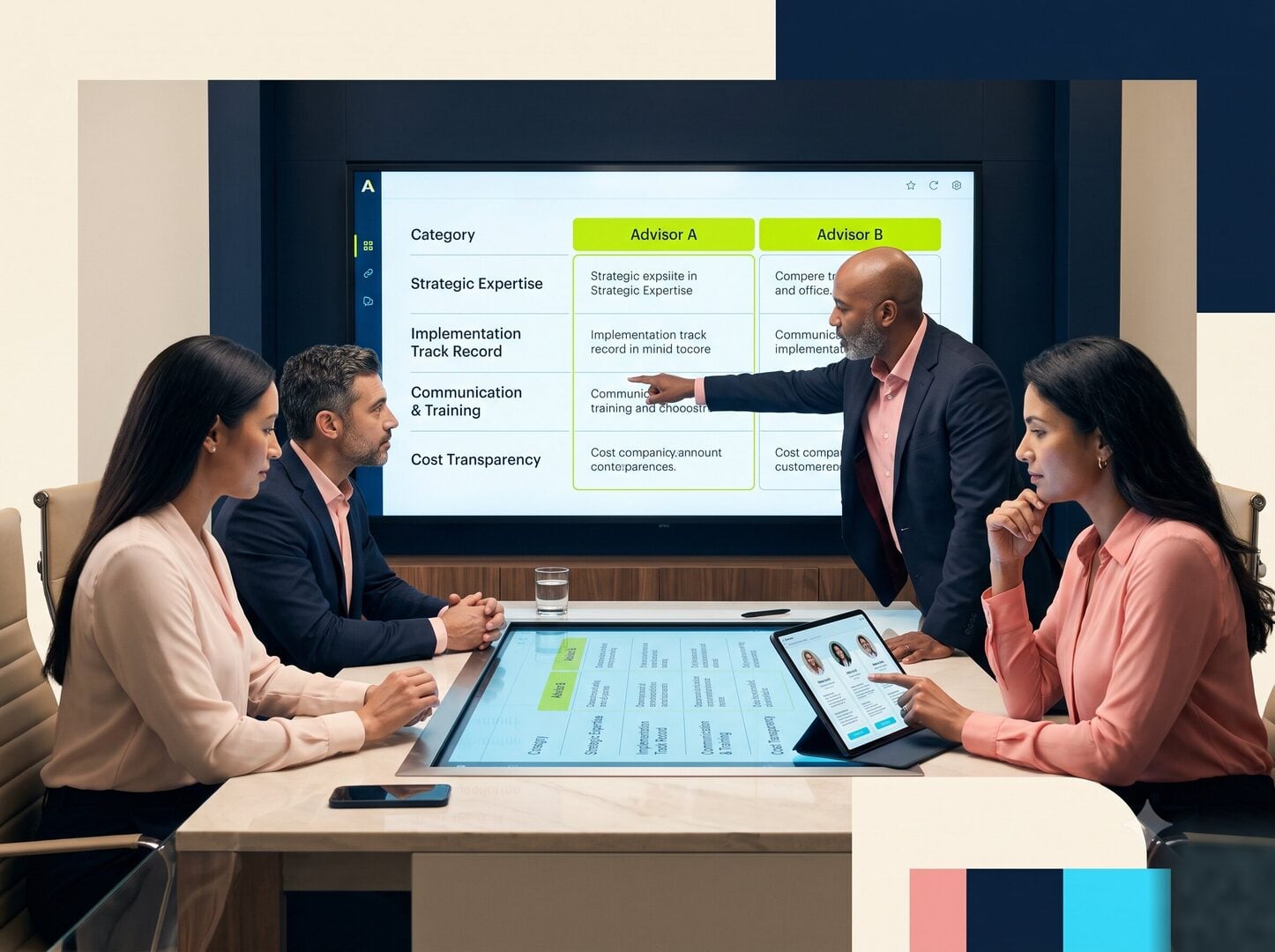
Generative AI Experts for Business: How Owner-Operators Can Evaluate, Compare, and Choose the Right Advisor in 2026
The AI Imperative for Owner-Operators in 2026
In 2026, the conversation has changed. A year or two ago, a lot of businesses were still experimenting with AI. They were opening accounts, testing prompts, and trying random tools. Now the pressure is different. Owner-operators are being asked a much harder question: What is AI actually doing for the business? If the answer is not revenue growth, cost reduction, faster delivery, or better team output, the excitement fades fast.
That shift matters because owner-operated businesses do not have endless time, spare budget, or internal AI teams. You are likely wearing multiple hats already. You are leading sales, operations, hiring, and client delivery at the same time. So when people start talking about generative AI experts for business, the real issue is not access to information. It is deciding who can help you move from noise to measurable ROI.
That is the core idea here. Buying software is not the same as building capability. To get real results from SMB AI adoption, you need three things working together: a clear plan, the right tools, and team training. In this guide, we will compare the main types of generative AI consultants, show what makes a strong advisor for owner-operated businesses, explain how to evaluate generative AI implementation partners, and give you a practical framework for choosing the right fit.

Comparing Experts in Generative AI for Business: Strategists, Implementers, and Trainers
If you are trying to compare experts in generative AI for business, start here: not every AI expert does the same job. That sounds obvious, but this is where many businesses get stuck. They hire a technical builder when they really need strategy. Or they hire a strategist who leaves them with a slide deck and no execution support.
1. AI Strategists and Advisors
A generative AI advisor helps you connect business goals to real AI opportunities. This person should be able to look at your workflows, bottlenecks, team capacity, and growth targets and say, “Here is where AI can create value first.” Good advisors help you de-risk decisions, compare vendors, set priorities, and build a roadmap tied to KPIs, not hype.
This is usually the right starting point if you feel overwhelmed, your team is experimenting without direction, or you need leadership clarity before spending more money.
2. AI Implementation Partners
Generative AI implementation partners are the people who turn the plan into a working system. They handle integration, workflow design, testing, deployment, and operational rollout. If a strategist says, “You should automate lead qualification, internal knowledge access, and first-draft content production,” the implementation partner is who actually builds it.
This matters for SMBs because implementation is where many AI projects stall. Advice is useful. A live solution inside your real workflow is what changes the business.
3. AI Trainers and Upskilling Partners
Then there is the third category: AI training. These experts help your team use AI safely, effectively, and consistently in day-to-day work. They reduce tool anxiety, teach practical prompting, and help people move from blank-page starts to faster execution. If your team does not adopt what gets built, your AI investment will underperform no matter how good the strategy was.
When Do You Need Which Type?
| Need | Best Fit |
|---|---|
| You need a roadmap and clearer priorities | AI Strategist / Advisor |
| You know what to build and need it deployed | AI Implementation Partner |
| Your team has tools but lacks confidence or consistency | AI Trainer |
| You need strategy, execution, and adoption support together | Hybrid Partner |
For many small businesses, a hybrid partner is the smartest choice. It is hard enough to manage one outside advisor. Managing three disconnected specialists usually creates handoff problems, duplicated work, and mixed accountability. If you want a deeper look at what that evaluation process can look like, this guide on how to hire and vet an AI consultant without getting burned is a helpful next read.
What Defines the Best Generative AI Consultants for Owner-Operated Businesses?
The best generative AI consultants for owner-operated businesses are not the ones with the flashiest demos. They are the ones who understand constraints. They know your business cannot pause for a six-month innovation project. They know your team may not be technical. And they know that if the work does not connect to margin, time saved, lead flow, or customer experience, it will not last.
First, look for pragmatism. Strong small business AI consulting starts with capacity, not possibility. A good consultant should help you map what your team can realistically adopt, what workflows are worth changing first, and what should wait. This is why workflow mapping matters so much. You are not looking for abstract ideas. You are looking for the bottlenecks that keep costing you time and money. That is also why operator-focused frameworks matter. If you want examples, this article on generative AI for owner-operated business operations shows how practical use cases tie to ROI.
Second, the right consultant talks in business outcomes. They should be asking about lead conversion, cost-to-serve, turnaround time, customer support load, and team productivity. If most of the conversation stays at the tool level, that is a warning sign. Tools change. Business outcomes are what matter.
Third, owner-led teams need cultural fit. The best generative AI consultants know how to work with lean teams where trust matters, speed matters, and everyone is already busy. They should be able to guide you without overwhelming your people. And they should offer ongoing advisory support, because AI decisions made in January may need adjusting by June. If you are weighing strategic options more broadly, the owner-operator’s guide to evaluating AI strategy consulting services is a useful companion.

From Theory to Reality: Evaluating Generative AI Implementation Partners for SMBs
Once you know where AI can help, the next question is simple: who can actually build it well? This is where evaluating generative AI implementation partners for SMBs becomes critical. Strategy gives you direction. Implementation determines whether anything changes in the real business.
A strong implementation partner does more than connect tools. They should understand your workflows, your team habits, your data sensitivity, and your current systems. That includes your CRM, project management stack, communication tools, and content processes. The goal is not a clever demo. The goal is a live, reliable solution your team will actually use.
Security and privacy matter here more than many small businesses realize. Even if you are not a giant enterprise, you still handle customer data, internal documents, pricing information, and operational knowledge. Your partner should be able to explain how they handle access, permissions, data flow, and safe AI usage in plain language. If they cannot explain it clearly, that is a problem.
You also want end-to-end support. Good partners help scope the project, build it, test it, refine it, and support adoption after launch. That might look like:
- AI-driven marketing workflows that speed up content planning and production
- Customer service bots that handle common requests before a human steps in
- Internal knowledge assistants that answer team questions faster
- Workflow automations for onboarding, follow-up, reporting, or operations
Just as important, the solution should be scalable. The right build for a 10-person company should not collapse when you grow to 25 or 40 people. If you want help thinking through use cases and investment levels, these resources on AI investment budget sizing for owner-operated businesses and how to compare and choose between AI investment options can help you pressure-test decisions before you commit.

A Practical Framework: How to Choose a Generative AI Advisor for Your Small Business
So how do you choose a generative AI advisor for your small business without wasting time or money? Keep it practical. You do not need a perfect process. You need a clear one.
Step 1: Ask About Their Framework
A serious advisor should have a repeatable process. Ask how they assess opportunities, prioritize workflows, measure success, and guide implementation. If the answer feels improvised, keep looking. Strong advisors usually have a structured way to move from discovery to roadmap to action.
Step 2: Check Whether Training Is Built In
Do they build the system and disappear, or do they help your team use it confidently? This matters more than most buyers expect. AI adoption fails when people are unsure, under-trained, or afraid of getting it wrong. If you want to avoid that, choose a partner who takes AI upskilling seriously.
Step 3: Look for Proof of Business Outcomes
Ask for examples tied to business results. Not just “we built an agent” or “we deployed automation.” Ask what changed. Did response time drop? Did output increase? Did labor shift to higher-value work? Did lead generation improve? The right advisor should be comfortable talking about AI ROI.
Step 4: Use the Discovery Call as a Test
A good discovery conversation should focus on your bottlenecks, workflows, goals, and constraints. It should not feel like a generic product pitch. If they spend more time naming tools than understanding your business, that tells you a lot.
Step 5: Review Flexibility
The best fit often offers more than one engagement style. Maybe you need project-based implementation now and ongoing advisory later. Maybe you need strategy first, then training. Flexibility matters because owner-operated businesses rarely need the same level of support at every stage. If cost is part of your evaluation, AI consulting costs for small business can help you set realistic expectations.
Bridging the Gap: The Role of Team Training and Upskilling
Even the best AI plan can stall if the team does not know how to use what gets built. That is the adoption gap, and it is one of the biggest reasons SMB AI adoption underperforms. People do not need more theory. They need hands-on practice in the context of their real work.
This is why training matters so much. Good AI upskilling reduces fear, speeds adoption, and helps employees see AI as a tool for better work, not a threat to their role. For owner-operated businesses, the best training is usually practical and role-based. Think workshops, guided implementation sessions, and applied courses where people build while they learn.
That is also why customized training is such a differentiator. Leadership teams need strategic clarity. Operations teams need workflow fluency. Marketing teams need repeatable content systems. Non-technical staff need safe, simple ways to use AI well. If you are trying to close that gap, how to train non-technical staff to use AI safely is a strong next step.
Transform Your Business with the Right AI Partner
The big takeaway is simple. Choosing among generative AI experts for business is not about finding the person who knows the most tools. It is about finding the partner who can connect strategy, implementation, and training to real business outcomes. For owner-operated businesses, that usually means choosing practical over flashy, measurable over vague, and integrated support over disconnected specialists.
If you are tired of guessing, this is the moment to get more structured. Ready to Transform Your Business with AI? Book a tailored consultation to identify your best AI opportunities and the fastest path to real results. Schedule your consultation today.