Generic AI Certifications vs Applied AI Business Courses: What Actually Moves Your Career Forward?
AI badges are everywhere, but not all training helps you actually change how your business runs. This guide compares generic AI certifications from Google and AWS with applied AI business programs like MIT Sloan and AI Smart Ventures’ Applied AI Course Level 1, so you can pick the option that builds real skills and measurable results — not just another line on your LinkedIn profile.
The AI training market has exploded. On any given week, a new certification pops up from a major tech platform, a business school, or a boutique consultancy. For managers and founders responsible for getting their teams AI-ready, the noise is exhausting. Which programs actually change how your business operates? Which ones look impressive but leave your team exactly where they started?
This guide cuts through that noise. We compare generic big-tech AI certifications against applied AI business courses, name specific programs, and give you a framework to decide what’s right for your team.

Let’s Define the Two Paths Leaders Usually Consider for AI Upskilling
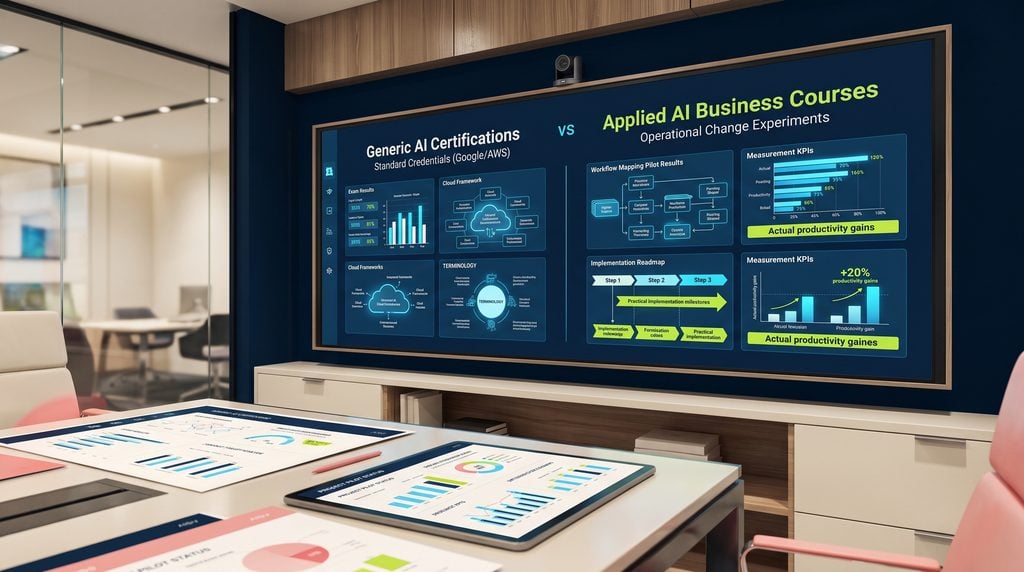
Generic AI certifications are standardized credentials issued by major technology platforms — Google, AWS, Microsoft, and others. They’re primarily designed to validate familiarity with AI concepts, cloud ecosystems, or specific vendor tools. Most are exam-based, self-paced, and focused on understanding frameworks and terminology rather than implementing AI in your own workflows.
Applied AI business courses take a different approach. Instead of proving you can pass a test, they’re built around getting you to run a real experiment inside your own organization. Curriculum is typically project-based: you map a workflow, design an AI-assisted change, pilot it, and measure the result. The deliverable isn’t a badge — it’s a documented change in how your business operates.
Most leaders who are driving AI adoption don’t need deep coding skills. What they do need is the judgment to identify the right use cases, the ability to lead their teams through change, and the practical experience of having done it at least once before. That’s a very different skill than passing a multiple-choice exam about model architectures.
Here’s Why the Type of AI Training You Choose Changes the Outcomes You Get
Consider two managers, both of whom spent six hours on AI education last quarter. One completed Google’s Generative AI Fundamentals certification and can now define transformer architecture and explain what a foundation model is. The other completed a cohort-based applied AI course and redesigned their client onboarding workflow — saving 4 hours per week per team member.
Both learned something real. But only one has a story that changes how their business works — and, increasingly, that’s the story that matters to boards, clients, and the team members they’re trying to lead.
Employers are getting better at reading this distinction. A vendor certification signals you engaged with a platform’s training materials. A portfolio of applied projects — even one completed use case with documented before/after metrics — signals you can lead AI initiatives in practice. For leaders responsible for ROI, the latter is the more credible signal.
This doesn’t mean certifications are worthless. They provide vocabulary, baseline literacy, and vendor ecosystem familiarity that are genuinely useful. The issue arises when certifications are treated as a substitute for applied practice rather than a complement to it.
What’s the Real Difference Between Big-Tech AI Certifications and Applied Business-Focused Programs?
The core difference comes down to what each type of training proves:
- Certifications prove knowledge. You passed an assessment that demonstrates you understand the concepts well enough to answer questions about them under exam conditions.
- Applied courses prove execution. You designed and ran a real experiment, documented what changed, and measured the impact.
Generic certifications tend to be vendor-specific, which means they reinforce a particular ecosystem (AWS, Google Cloud, Microsoft Azure) rather than building the tool-agnostic judgment that most business leaders actually need. They’re also often technically oriented — built for data engineers, ML practitioners, and cloud architects — even when they’re positioned for business audiences.
Applied AI business courses, by contrast, typically start with a business problem rather than a technology. They ask: Where are you losing time or money? Where does a human make a decision repeatedly that could be assisted or automated? The AI tool is chosen to fit the workflow, not the other way around.
A useful mental model: certifications fill the bottom of your AI capability stack (vocabulary, conceptual literacy, ecosystem fluency). Applied courses build the execution layer on top (use case design, change management, workflow integration, ROI measurement). Both layers matter; neither alone is sufficient.
Here’s How Google, AWS, MIT Sloan, and AI Smart Ventures Stack Up
Rather than speaking in abstractions, let’s compare specific programs.
| Generative AI Leader | Self-paced, exam-based | Gen AI concepts, Google Cloud ecosystem | Tech teams, cloud practitioners | |
| AWS AI Practitioner | Amazon Web Services | Self-paced, exam-based | AI/ML fundamentals on AWS | Teams adopting AWS AI services |
| AI for Business | MIT Sloan / various | Online cohort, case-based | AI strategy, leadership, ethics | Senior leaders, executives |
| Applied AI Course Level 1 | AI Smart Ventures | Cohort + hands-on labs | Workflow design, real use cases, ROI measurement | SMB owners, managers, ops leaders |
Google Generative AI Leader is a strong foundation for teams who want to understand generative AI concepts and how Google Cloud capabilities fit together. It’s primarily technical in orientation and well-suited for practitioners who will implement or oversee Google Cloud-based AI projects.
AWS AI Practitioner covers foundational AI and machine learning concepts in the context of the AWS ecosystem. It’s the right starting point for organizations standardized on AWS who want baseline literacy across a broader non-technical team.
MIT Sloan’s business AI programs bridge strategy and technology. They use case-based learning to help senior leaders understand competitive implications, governance considerations, and organizational change. They’re executive-grade programs with executive-grade price tags.
AI Smart Ventures’ Applied AI Course Level 1 is the most hands-on, SMB-focused option on this list. Participants don’t just learn about AI — they design, test, and measure a real AI use case drawn from their own business during the program. The curriculum covers workflow mapping, prompt engineering, data privacy, and change management, and connects directly into advisory and implementation services for organizations that want to keep moving after the course ends. For owner-operated businesses that want specialist guidance rather than enterprise overhead, this is the most direct path from learning to results.
What Should Managers and Founders Pick Based on Their Goals?
There’s no universal right answer, but there are clear patterns based on what you’re trying to accomplish:
If you’re an SMB founder who needs your operations AI-ready fast: Start with AI Smart Ventures’ Applied AI Course Level 1. You’ll leave with one working use case, a measurement framework, and a roadmap — not just a badge. Supplement with a Google or AWS foundational certification if your team is actively building on those platforms.
If you’re a marketing or operations manager responsible for a team: A vendor certification gives you vocabulary to work with technical partners. An applied course gives you a use case to lead. Ideally, do both — in that order. Consider role-specific AI training that targets the functions your team actually performs.
If you’re building an internal AI champion or center of excellence: You need more than personal upskilling — you need a structured curriculum that produces the CoE’s actual operating artifacts: use case inventories, governance frameworks, adoption playbooks. Applied courses with advisory support are better suited here than self-paced certifications.
If you’re an executive responsible for AI strategy: MIT Sloan-style programs provide the executive framing. But pair them with at least one applied experience — even a short workshop — so you’ve run a real experiment rather than just read case studies about them. Leaders who’ve done it once lead AI initiatives very differently from those who haven’t.
Here’s How to Turn Any AI Course Into Real Business Results
The biggest failure mode in AI training isn’t choosing the wrong program — it’s completing a program without ever running an experiment. Here’s a simple five-step process to change that:
- Pick one workflow. Choose something you do repeatedly — a process that takes more than an hour a week and produces a consistent type of output (a report, an email, a summary, a decision).
- Map it. Document the current steps, inputs, decision points, and time required. This is your baseline.
- Design a small AI-assisted change. Don’t try to automate the whole workflow. Find one step where AI assistance could reduce time or improve consistency, and design that specifically.
- Run a short pilot. Test it for two to four weeks with one or two team members. Keep the original process running in parallel so you can compare.
- Measure and document. Compare time-per-task, error rate, output quality, or whatever metric matters most. Document what you did and what changed.
This loop — identify, design, pilot, measure — is what separates teams that build real AI capability from teams that take courses and go back to business as usual. If you want to run AI training that actually sticks, this practice loop is what makes the difference.
What Questions Should You Ask Before Investing in Any AI Training Program?
Before enrolling your team in any program — whether it’s a vendor certification or an applied course — use this checklist:
- What does a participant produce during the program? If the answer is “they pass an exam,” probe further. If the answer is “they complete a use case in their own workflow,” that’s more useful.
- How current is the content? AI tools evolve quickly. Ask when the curriculum was last updated and how often it changes.
- Is data privacy and AI governance covered practically? Not as an abstract risk lecture, but as applied guidance for what your team should and shouldn’t share with AI tools. See our guide on how to evaluate whether an AI training program will actually deliver business results for a full framework.
- What happens after the course ends? Is there follow-on support, implementation help, or access to advisors? Or does the relationship end when the cohort does?
- Can you talk to past participants? Ask for references who can speak to what changed in their business after completing the program.
- How does the provider measure success? If they measure it only by completion rates and satisfaction scores, that tells you something. If they measure it by use cases deployed and business outcomes documented, that tells you something different.
If you’ve noticed that training alone isn’t driving adoption in your organization, these questions will help you identify why — and what to look for instead.
Next Steps If You Want Applied AI Skills, Not Just Another Certificate
The core insight of this guide is simple: certifications prove knowledge; applied courses prove you can deliver outcomes inside your own business. Both have their place. But for most managers and founders who need their teams AI-ready — not just AI-informed — applied practice is where the real capability gets built.
If you want to take the next step, AI Smart Ventures offers the Applied AI Course Level 1 for owners, managers, and operators who want hands-on training tied directly to their own workflows. The course includes guided labs, a structured use case framework, and post-course advisory support for teams that want to keep moving.
If you’re not sure where to start, a consultation can help you map your team’s current AI capability, identify the highest-value use cases, and design a training roadmap — whether that includes certifications, applied courses, or both. The goal isn’t more badges. It’s a team that runs better because of AI.