How Can a Surveying Firm Use AI Without Risking the Report?
Last Updated: October 2026
AI in land surveying is the use of AI tools on the work around a survey, not on the survey itself. It sorts site photos, types up field notes, drafts the written parts of a report, and checks a draft against the scope a client signed. It does not measure, and it does not decide where a line falls. A licensed surveyor seals the finding, and that seal puts their own name at risk.
AI Smart Ventures has guided growing businesses through AI adoption in work that one named person has to sign. Survey firms sit squarely in that group. The firms that move fastest wrote down early which jobs a tool may touch, and which ones never leave the licensee’s desk.
Get that split wrong and the cost is not a lost afternoon. A boundary opinion rests on proof you can show and defend years later. A finding you cannot trace back to your own reasoning is the one that falls apart under questions. Get it right and the same tools hand back the hours that site visits and paperwork quietly eat.
Key Takeaways
- The seal sets the line, not the software: the North Carolina Board of Examiners for Engineers and Surveyors told licensees in July 2025 to “maintain responsible charge over all aspects of the work” when AI is used.
- Most AI use is still a trial run: RICS research across 3,148 property and construction professionals, out on 18 August 2026, found 39% piloting AI and just 4% in construction using it widely.
- Put it in the contract, not a footnote: the RICS AI standard, in force from 9 March 2026, asks firms to tell clients in writing, and up front, when and why AI is used.
- Keep only what you can rebuild yourself: output you could not redo without the tool is not ready to sit behind your seal.
Those four say one thing in four ways. What counts is not how clever the tool is, but whether a person can stand behind each line of the finished page, and that is why the groundwork is where the gain sits.
What can AI do before a survey is sealed?
Nearly all the paperwork around the finding. AI can sort a day of site photos by place and subject, turn a voice memo from the truck into typed field notes, and draft the written parts of a report from your past work. It can read a draft against the signed scope and list what is missing, and it can set two logged readings side by side and tell you they clash. What it cannot do is decide which one is right.
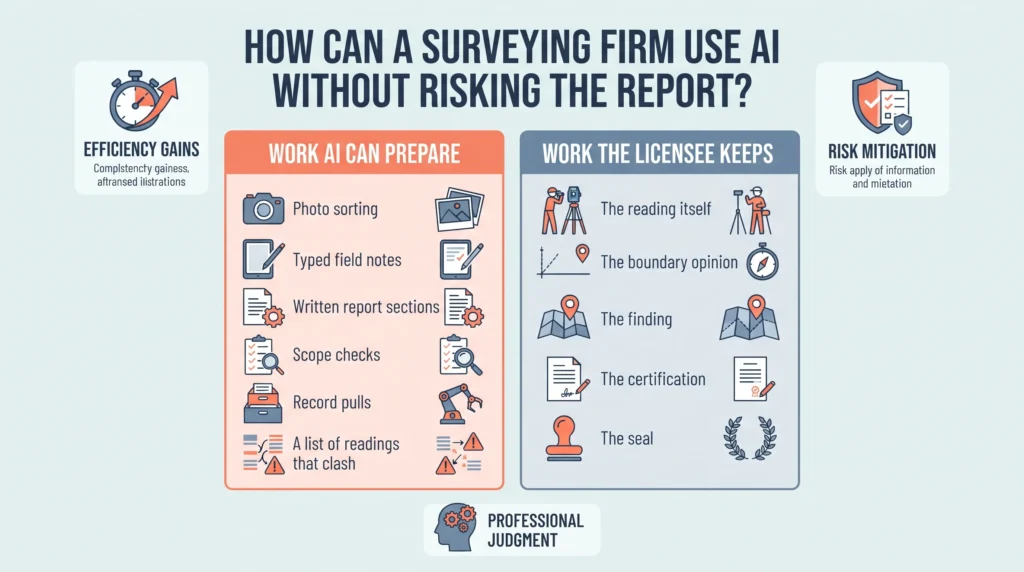
That list surprises most principals, because the sealed finding is a small part of a long report. The rest is description, references, history and layout. A person still puts all of it together by hand. Hand that to a tool and the licensee spends their hours on proof and judgment instead. The split also makes AI adoption easy to explain, since nobody has to guess whether a task crossed a line.
Why does the seal set the limit, not the tool?
Because the seal is a promise from a person, not a file format. Your signature says you ran the work and will answer for it. North Carolina’s board said as much in guidance approved on 16 July 2025: a licensee using AI must “exercise direct control, maintain complete oversight of all data inputs, and be capable of reproducing the output independently from any AI program.” If you could not redo it without the tool, you were not running it.
That is one state’s wording, quoted here as a model and not as a rule that reaches your office. Your own state board sets what responsible charge means where you work. Your insurer sets what it will cover. Both calls are short, and worth making before a tool touches live jobs. This article is not surveying, engineering or legal advice, and none of it replaces what your board tells you in writing.
| AI can prepare | The licensed surveyor keeps |
|---|---|
| Sorted photos, typed notes, record pulls | The reading and how it was taken |
| Draft written and background sections | The boundary opinion |
| A scope check against the signed agreement | The finding and the certification |
| Readings that do not agree | Which one is right, and why |
Which groundwork tasks give back the most time?
Start with the three that repeat on every job: photos, notes and the scope check. A crew comes back with hundreds of images that no one labels until someone needs one. Field notes sit in a book or a voice memo until a draft is due. And the last read against the client’s scope gets done late, at speed, by the person least able to see it clearly. Each one is a sorting job, which these tools do well.
The fourth task earns its place for a different reason. Ask a tool to list each place where two logged values clash, and it will find pairs a tired reader skips. It is not giving you the answer. It is telling you where to look, which is checking at its simplest. Treat that list as questions for a person, never as a fix. That habit is where AI literacy in a survey office starts, and it keeps machine sorting of raw scan data honest.
What has to be checked before you seal it?
Everything the tool touched, against something you trust. Check typed notes against the recording or the book. Check a photo caption against the image. Check each figure in the written text against the source record, one by one. A smooth sentence with a wrong call number still reads as correct. Then ask what that board’s test implies: could you make this output again from the raw data, with no AI in the room? If not, the draft goes back.
Software that sorts scan and image data needs exactly the same doubt, and the published research says so. A 2025 study in the ISPRS Archives by Haval AbdulJabbar Sadeq, out on 19 May 2025, reports that filtering LiDAR data for ground points “remains a challenge”, and that a finer eight-class model showed “more misclassification, especially in complex urban areas”. Sorted output is a starting point for a person, not a result.
AI Consulting maps where AI sits in your week and where the licensee signs off. That is the change management and capability building that make AI implementation hold once the novelty wears off.
How do you describe AI use in your scope?
Say it in writing, before work starts, in the scope letter rather than in a chat. Name the jobs: photo sorting, typing notes, draft text. Then say the part clients care about most, which is that a licensed surveyor runs the survey, forms the opinion and seals the report. RICS, the global body for chartered surveyors, now asks its regulated firms to make clear to clients “in writing and in advance” when and why AI is used.
That standard, Responsible use of artificial intelligence in surveying practice, came out in September 2025 and is in force from 9 March 2026. It does not govern a US license; your state board does. It is still the clearest model of a written notice, and it asks for a named surveyor to stand behind any output the firm leans on. Vendors selling automation as AI say clients would rather not hear about it. AI Smart Ventures observes the reverse: clients mind a late surprise far more than an early word.
Frequently Asked Questions
Can AI replace a licensed land surveyor?
No, and the reason is legal rather than technical. A survey is a survey because a licensed person took the job on and will answer for it, which no software can do. AI can build the file, sort the proof and speed up the writing. The reading, the boundary opinion and the seal stay with the person whose license is at risk. The role shifts toward judgment, which is where the value sat anyway.
Which AI tools fit the groundwork side of surveying?
General tools do most of this: a speech-to-text tool for field notes, a photo library that sorts by place and subject, and a chat assistant for drafts and scope checks. Specialist software handles scan and image data. Pick by what the task needs, not by the feature list. Make no claim about a named product’s accuracy unless you have tested it against your own control. Run one tool on one job first.
Will quantity surveyors be replaced by AI?
Not the judgment part. Measuring and takeoff work can be partly automated, but reading contracts, allowances and project risk rests on a person who answers for the number. RICS, which regulates chartered surveyors, put out an AI standard in September 2025 that keeps a named surveyor on the hook for any output the firm leans on. The work shifts toward checking and explaining, which is harder to hand over.
Can AI set a boundary line from old deeds?
No. AI can pull records, lift call numbers and lay rival descriptions side by side, which saves real hours in a title search. It cannot weigh proof that conflicts, apply the order of precedence or decide what controls on the ground. That thinking is the act a boundary opinion is made of. Use the tool to build the file, then read the file yourself and write the opinion in your own words.
Is a drone flight with AI processing still a survey?
Only if a licensed surveyor runs the work and answers for the result. Drones and scanners pick up site data, and software turns it into something you can read. Neither step makes a survey. The licensee sets the control, judges whether the data suits the job, and decides what the finished product says. Ask your state board how aerial data may be used in sealed work.
Who is liable if an AI step causes a survey error?
The person who sealed the report, in practice. A seal says the licensee was in responsible charge, so an error that reaches a client is theirs to answer for, whatever made it. Two calls settle the detail: your state board on what responsible charge asks of you, and your liability insurer on what the policy covers. Both would rather be asked up front than after a claim.
Can AI write the legal description for a plat?
It can draft one from your data, and that draft has to be read line by line against the record. Written calls are where a confident tool does the most harm. A wrong bearing inside a tidy sentence looks right. Read each call, distance and note against the source. Plenty of firms keep this writing fully manual for that reason, and that is still a fair choice.
Should field notes be typed up by an AI tool?
Yes, this is one of the safest uses there is, as long as the source file survives. Record the note in the field, let the tool type it, then read the text against the tape before you delete anything. The typed copy is a help, not the record. Keep the raw audio or the book as your records policy asks. Never let a vendor’s default setting decide how long a project file lasts.
How do you check an AI-sorted point cloud?
Spot-check it against known control and against your own eyes. Pick sample spots in the hardest ground on the job, often thick growth, steep slopes or built-up blocks, and set the sorted result beside the raw data. Published work shows these errors cluster in complex urban scenes rather than spreading evenly. Write down what you sampled and what you found, since that note shows you kept watch rather than took an output on trust.
Where should a survey firm start with AI?
Pick the one job that repeats on every project and wastes the most hours, often photo sorting or field notes. Run it for a month with a written rule on who checks the output and where the source file is kept. Scope drives the commitment: one workflow with clear sign-off takes weeks, not a rebuilt office. Schedule a consultation with AI Smart Ventures to pick that first job.
Executive Summary
AI in land surveying works on the groundwork behind the report: sorting site photos, typing field notes, drafting the written parts, checking a draft against the signed scope and flagging readings that clash. The reading, the boundary opinion, the finding and the seal stay with the licensed surveyor, because the seal is a claim of responsible charge. Check what the tool touched against a source you trust. Treat output you could not redo yourself as unfinished, and tell clients in writing which tasks AI helps with and who signs.
What Should You Do Next?
This week, list what your firm turns out on a normal job and mark each part as groundwork or finding. Take the groundwork list and pick the one job that repeats most. Then write a single page saying who checks the output, what it is checked against, and where the source file stays. Send that page to your board contact and your insurer before the first live run.
AI Smart Ventures offers AI Consulting for growing businesses that need practical AI in work one person has to sign. Schedule a consultation to set an AI strategy your licensees and your insurer can both live with.
People Also Read
- Jasper for Business Owners: Is It Worth It After Free ChatGPT?
- AI for Press Releases and Founder Statements That Sound Like You
About the Author
Nicole A. Donnelly is the Founder of AI Smart Ventures and an AI Adoption Specialist with 20 years of experience as a founder and CEO and over a decade leading AI adoption initiatives. She helps businesses integrate artificial intelligence with clarity and confidence, driving innovation and sustainable growth. Nicole has trained over 20,217 professionals in Applied AI, delivered 624 workshops, and worked with close to 1,000 organizations across diverse industries.
Expertise: AI Transformation, AI Strategy, AI Implementation, AI Adoption, Applied AI, Marketing, Business Operations
Disclaimer: This content is for informational purposes only and does not constitute professional business or technology advice. Results vary based on industry, existing systems and implementation commitment. Contact AI Smart Ventures for a consultation regarding your specific situation.