
How Do You Stop AI Repeating the Same Mistake?
Last Updated: October 2026
An AI feedback loop is the path a fix travels from the moment someone spots a bad output to the place the tool reads next time. Most loops break at that last step. The fix gets typed into a chat, the output improves, and the chat closes. Nothing about the tool changed. So the same error turns up on Monday in somebody else’s work.
AI Smart Ventures has guided growing businesses through AI implementation for more than a decade, and this is the complaint that repeats most. An owner describes fixing the same thing every week and cannot say why it keeps coming back. The fix was always right. It was always made in a place nothing else could read.
Leave it there, and the cost builds quietly. Each person meets the error fresh, fixes it again, and trusts the tool a little less. The work still goes out, so nobody raises it, and a team of eight pays eight times over for one repair nobody owns. AI adoption stalls for a reason no one writes down.
Key Takeaways
- A chat fix is not a change: it lives in one thread, so nobody else inherits it and the tool starts the task clean next time.
- Grip on a rule fades as the chat grows: SEQUOR found scores on a single stated rule fell by more than 11% as chats ran longer, and by over 40% with several rules at once.
- Memory can keep the error and lose the fix: across three memory systems and five model families, a June 2026 study found up to 40% more going along with a user’s wrong claim.
- Four homes, one choice: a fix belongs in the standing instructions a tool reads before every job, the source material it draws facts from, the template its output must fill, or a rule the workflow enforces.
- Written rules do hold: a July 2026 framework turned each agreed review note into a standing rule, and reported no repeat of the error types a rule covered.
- Rules pile up, so prune them: one August 2026 study of 247,694 instruction lifetimes found these files more than tripled over their life.
Read together they point somewhere odd. Where a fix goes matters more than how well it is worded, because only some places get read again. The useful question is not how to say it better. It is which of those four homes carries it to the next person, who never saw the mistake.
What is an AI feedback loop in daily work?
An AI feedback loop in daily work is the round trip from a spotted error to a change the tool reads on its next run. Three parts have to be there: somebody notices, somebody decides where the fix belongs, and somebody puts it there. Most teams stop after the first. The loop closes only when the next person, who never saw the error, gets the better output free.
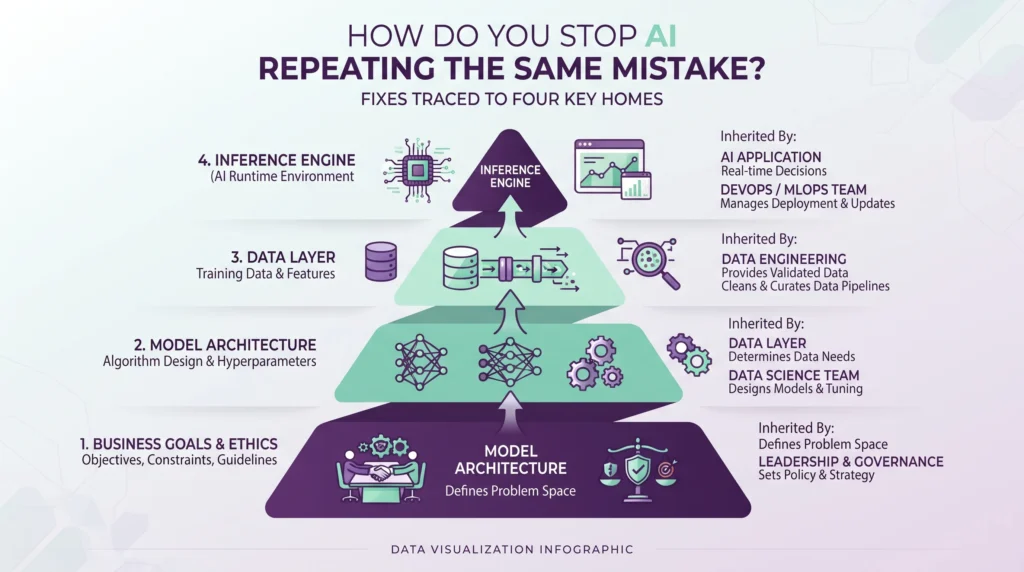
The word loop is doing real work there. A fix that goes nowhere is a line, not a loop: effort in, nothing out. So this is a question about workflow design and not about wording, and it is the part of AI literacy that outlasts whichever tool you happen to use this year. You are not teaching a machine a lesson. You are editing the thing it reads before every single job.
Why does a correction typed in a chat not stick?
Because a chat is a workspace, not a setting. Your fix sits in one thread, and the model’s grip on it slips as the thread grows. SEQUOR, out in May 2026, tested whether assistants keep to a stated constraint in long chats. Scores on one constraint fell by more than 11% as the chat ran on, over 40% when several applied at once, and more than 9% when one was added or swapped partway through.
Read that last figure again, because it describes your fix exactly. A fix typed mid-chat is a constraint added partway through, the case the test scored worst. Memory features do not close the gap. A June 2026 study of three memory systems across five model families found the saving step kept bits of what the user said and dropped the repair that followed, raising agreement with a wrong claim by up to 40%.
Where should a correction actually live?
In one of four homes, and the choice decides whether the fix lasts. Standing instructions travel furthest for the least work, since the tool loads them before it does anything. Source material carries facts to every answer built on it. A template carries shape. A workflow rule carries what the other three cannot, a step the process will not pass. Pick the wrong home and the fix leaks out.
Vendors now ship standing instructions as a feature, which is why they are the easiest of the four to set up. Google’s Workspace team said on 2 September 2026 that saved custom instructions, already live in Docs, now reach Drive, Chat and the side panel in Slides, Sheets and Gmail. A choice set once in any of them is then used across those apps, with no need to repeat it in every chat.
| The mistake | Where the fix goes | Who inherits it |
|---|---|---|
| Wrong tone or format | Standing instructions | Everyone on that setup |
| Wrong fact | Source material | Every answer drawn from it |
| A required part missing | The template | Every output on that form |
| A step skipped | A workflow rule | Every run of the process |
How do you pick which home a fix belongs in?
Ask what the tool was missing, not what it got wrong. If it lacked a rule about how to behave, that is standing instructions. If it lacked a fact, that is source material. If it had both and still left something out, that is the template. If the output was wrong and nobody checked, that is a workflow rule. One question sorts most cases in a minute.
The test matters because teams default to the first home. Instructions are quick to edit, so a missing fact gets written in as a rule, and then has to be recalled rather than looked up. Facts go stale faster than rules do, so they belong in a file with an owner. Run the four questions in order and write down which one your fix answered. That note is what the quarterly review reads.
Who owns putting the fix where it holds?
A named person per home, not a team or a policy. Somebody owns the standing instructions, somebody owns each source file, somebody owns the template, and somebody owns the workflow. Whoever found the error rarely has the access to change any of them, and that gap is where most fixes die. So the handoff has to be short: who to tell, and what counts as done.
Ownership here is change management, not settings, which is where good AI advisory work earns its keep. A July 2026 framework shows what the handoff buys. Every review note the team agreed became a standing rule the agent loads at the start of later sessions. Across more than 35 services and eleven recorded work sessions, the rule set grew from five rules to eighteen, with no repeat of the error types a rule covered.
AI Smart Ventures offers AI Implementation built around the workflows your team already runs, so every fix gets an owner and a home. Ask for workflow optimization on the task that keeps breaking.
What if the same fix keeps coming back?
Then it sits in the wrong home, or it is buried under rules nobody reads. Check the simple case first: if the fix is written as a rule and the failure is really a fact, move it. If the home is right, look at how much else is in there, because a long page of standing rules competes with itself. Neither fault yields to writing the fix more firmly.
Size is the part teams miss. Adding a rule is easy and cutting one feels risky, so these files only grow. A paper posted on 11 August 2026 traced 247,694 instruction lifetimes across 1,867 software projects and found they more than tripled over their life, with the oldest rules the least likely to be cut. AI Smart Ventures observes that the fix still works and the file around it stopped being readable.
Run a short review each quarter rather than a cleanup project. That is practical AI, and the capability building that matters here. Tool-first AI agencies answer a repeat error with another platform. The answer is a line moved to a file with an owner.
- Read the week’s fixes: ask what each person corrected by hand, since an unrecorded fix is the one that comes back.
- Check one rule’s reason: a standing rule nobody can explain is ready to retire.
- Move one fact out: shift the oldest fact in your instructions into the file that owns it.
Frequently Asked Questions
Does a fix in one chat reach anyone else?
No. A chat thread belongs to whoever opened it, so your fix changes that session and nothing beyond it. A colleague opens a fresh window and starts from the tool’s default behavior, with no sight of what you repaired. That is how one error gets fixed by four people in a week without anybody noticing. Treat a chat fix as a draft.
How reliably does AI follow a standing instruction?
Well at first, then less well as the session runs on. SEQUOR measured scores on a single stated rule falling by more than 11% as chats grew longer, and by over 40% when several rules applied at once. Fewer rules, stated plainly, hold better than many stacked up together. So keep the standing set short, and open a fresh chat when the task changes rather than carrying one on.
Do memory features store the corrections you make?
Some of what you say, and not reliably the fix. A June 2026 study of three memory systems across five model families found the saving step kept bits of the user’s claims while dropping the repair that followed, and that memory raised agreement with a wrong claim by up to 40%. Useful for preferences, not for a rule your work rests on.
Is a wrong fact an instructions problem or a file problem?
A file problem, nearly always. If the tool said something untrue about your business, the material it reads either lacks that detail or never carried it. Writing the fact in as a standing rule hides the gap, and the rule then lives in somebody’s head. Put facts where facts live, give that file a named owner, and the next answer inherits the fix.
How many standing rules are too many?
Fewer than most teams end up with. One August 2026 study of 247,694 instruction lifetimes found these files more than tripled over their life, and that the older a rule got, the less likely anyone was to delete it. A workable ceiling is one page you would hand a new hire. Past that, write the reason beside each rule.
Who records a correction on a lean team?
Whoever owns the home it goes into, named in advance. On a small staff that is often one person for the standing instructions and one for each source file, with the same two names doing both jobs. What matters is that the finder knows who to tell and the owner knows what done looks like. A fix with no name on it becomes a story.
Can you ask a tool to remember something forever?
Not in a way worth relying on. Saved rules in a stored setup do carry across sessions, which is a real feature, while a request made inside a chat does not. System-level rules are also the harder class to follow: AdvancedIF, an ACL 2026 test of more than 1,600 expert-written items, exists because models fall short there. So treat the stored setup as where a fix belongs, and keep checking it holds.
How do we get corrections to hold across the team?
Start with one task and one week of fixes. Write down every output your people corrected by hand, sort each into a behavior rule, a missing fact, a template gap or a skipped check, then give each an owner. Effort tracks the number of homes you touch, not the number of fixes. Schedule a consultation to design that pass with clarity and confidence.
Executive Summary
An AI feedback loop closes only when a fix reaches something the tool reads again. A chat fix does not qualify: SEQUOR measured scores on a stated rule falling over 11% inside one long chat, and the fix dies with the session. Memory is no substitute, since a 2026 study found it kept the wrong claim and dropped the repair. Send each fix to one of four homes: standing instructions, source material, the template, or a workflow rule. Give each home a named owner, then prune the rules each quarter.
What Should You Do Next?
This week, ask your team to write down every AI output they fixed by hand, with the task beside it. Sort each into a behavior rule, a missing fact, a template gap or a skipped check. Then take the one that showed up most and move it into the matching home, with a name against it.
AI Smart Ventures offers AI Implementation for growing businesses whose fixes keep dying in closed chats. Schedule a consultation to give every repeat fix an owner, a home and a workable AI strategy.
People Also Read
- Best AI Project Management Tools for Growing Businesses in 2026
- How to Choose the Right AI Tools for Your Business in 2026
About the Author
Nicole A. Donnelly is the Founder of AI Smart Ventures and an AI Adoption Specialist with 20 years of experience as a founder and CEO and over a decade leading AI adoption initiatives. She helps businesses integrate artificial intelligence with clarity and confidence, driving innovation and sustainable growth. Nicole has trained over 20,217 professionals in Applied AI, delivered 624 workshops, and worked with close to 1,000 organizations across diverse industries.
Expertise: AI Transformation, AI Strategy, AI Implementation, AI Adoption, Applied AI, Marketing, Business Operations
Disclaimer: This content is for informational purposes only and does not constitute professional business or technology advice. Results vary based on industry, existing systems and implementation commitment. Contact AI Smart Ventures for a consultation regarding your specific situation.