How to Scale Content With AI Without Losing Your Brand Voice: A Practical Guide for Owner-Operated Businesses in 2026
Key Takeaways
- You can scale content with AI without sounding generic if you train the system on your real voice, not a vague prompt.
- Lazy AI creates robotic content. Strategic AI creates leverage. The difference is process, guardrails, and human review.
- Owner-operated businesses need a repeatable AI-driven content engine that turns one idea into blogs, emails, and social posts.
- The best AI marketing firm will not rush to generate content on day one. It will first learn your brand, audience, and workflow.
- AI marketing consulting matters most when your time is limited. The right advisor helps you choose tools, set standards, and tie content to ROI.
The AI Content Dilemma for Owner-Operated Businesses
By 2026, AI is no longer a novelty in marketing. It is table stakes. Your competitors are already using it to draft blogs, repurpose videos, build email sequences, and push out more social content than a small team could produce manually.
That sounds like good news until you are the founder whose voice built the brand in the first place.
For owner-operated businesses, the fear is not just “Will AI work?” The deeper fear is, “Will this make us sound like everyone else?” If your audience trusts your point of view, your tone, and the way you explain things, generic output is not a small issue. It is a brand risk.
This is where it helps to separate lazy AI from strategic AI. Lazy AI is what happens when someone opens a tool, types “write me a blog post,” and hopes for the best. Strategic AI is different. It uses real brand inputs, clear editorial rules, human review, and a system built around quality. That is how you scale content with AI without losing the connection that made your business work in the first place.
In this guide, we will walk through the practical path. We will cover how to maintain brand voice, how to build an AI-driven content engine, how to evaluate an AI marketing firm, and why AI marketing consulting is often the fastest route for owner-operated businesses that want results without the chaos.

How to Maintain Brand Voice and Avoid Sounding Like a Robot
If you want to use AI for marketing without sounding like a robot, start here: AI cannot protect a voice you have never defined. Most businesses think they have a brand voice because the founder can “feel” when something is off. That instinct matters, but it is not enough to scale.
The first move is to build a Brand Voice Sandbox. This is a living document or prompt environment that teaches your AI how your brand actually sounds. Include tone descriptors, strong examples, and negative constraints. Tell the system what to do, but also what to avoid. If your brand is direct, practical, and warm, say that. If you never use hype, jargon, or stiff corporate language, say that too.
A strong sandbox usually includes:
- 10 to 20 examples of your best-performing content
- A list of phrases you use often
- A list of phrases you never want to see
- Guidance on sentence length, reading level, and tone
- Real audience context, including what they worry about and how they talk
Next, feed the AI your historical winners. Your best blogs, emails, founder posts, sales notes, and webinar transcripts are far more useful than generic prompting tricks. AI learns cadence from examples. If you want it to sound more like you, show it you. This is one reason posts like What Is Writer and How Do Owner-Operated Marketing Teams Keep Their Brand Voice? are so relevant right now.
Then apply the 80/20 Rule. Let AI create the first 80 percent: structure, draft flow, repurposing, headline options, and first-pass copy. Keep the final 20 percent human. That last layer is where nuance lives. It is where you add judgment, current context, emotional tone, and the subtle choices that make content feel real. In practice, this is often the difference between “good enough” and “that sounds exactly like us.”
You also need to remove the obvious AI tells. Ban filler words and recycled phrasing. Words like “delve,” “tapestry,” “testament,” and other overused patterns are easy signals that the draft came straight from a machine. Vary sentence structure. Mix short sentences with longer ones. Use contractions. Ask direct questions. Read the draft out loud. If it sounds like something you would never say to a client, it is not ready.
Finally, create editorial guardrails by channel. Your blog should not sound exactly like your email. Your email should not sound exactly like LinkedIn. Build custom GPTs or assistants for each content type, each with its own rules. The brief you use for a newsletter should be different from the brief you use for a founder post. If you want a practical starting point, AI Briefing Templates for Agencies: How to Pre-Brief AI Right is a smart next read.

Building an AI-Driven Content Engine for Omnichannel Scale
Before you buy more tools, map your current workflow. This step gets skipped all the time, and it is why so many AI rollouts create more mess instead of more output. You need to know how content moves through your business now. Where do ideas come from? Who approves them? What takes too long? Where does quality break down?
Once you can see the workflow, you can build the engine.
A practical AI-driven content engine for an owner-operated business usually starts with one core asset. That might be a founder video, a podcast episode, a webinar, or a long-form article. From there, AI helps extract and repurpose. One strong source can become:
- 1 blog post
- 3 email sends
- 10 social posts
- 2 short video scripts
- 1 sales follow-up sequence
That is how scale happens without creating from scratch every time.
The next piece is your stack. You want a simple, connected system. In most cases, that means an AI writing layer, a place for briefs and approvals, your CMS, your email platform, and a light QA workflow. Do not overbuild this. The goal is not complexity. The goal is reliability. For many businesses, the real unlock is not the tool itself. It is the process around the tool. That is also why Building an AI-First Marketing Function: A Guide for Owner-Operators is worth your time.
Standardized briefs matter more than people think. AI performs better when it starts from a strong outline, clear audience intent, and channel-specific instructions. Blank-page prompting creates weak drafts. Strong input creates usable output. So build a standard brief that includes audience, offer, voice notes, source material, CTA, and examples of content that sounds right.
Then add QA loops. You need checks for factual accuracy, brand alignment, and drift over time. AI output can get worse slowly if no one is watching. A system for periodic review protects quality at scale. Two useful resources here are AI Quality Scoring for Owner-Operators: Auditing AI Output Without Reading Every Word and AI Drift: How to Catch When Your AI Outputs Are Getting Worse.
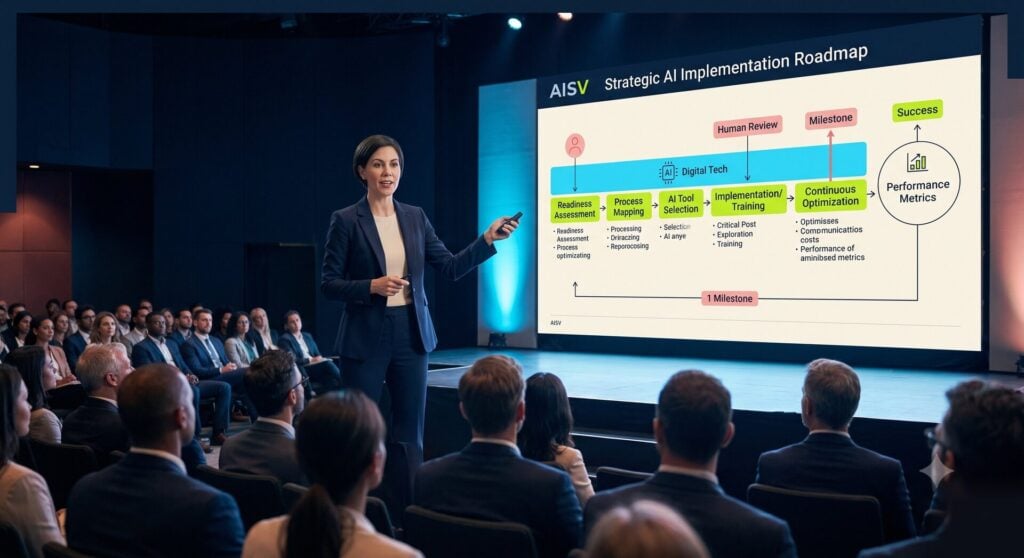
Choosing the Best AI Marketing Firms for Authentic Content Scale
If you are asking which AI marketing firms can help you scale content without it sounding generic or obviously AI-generated, the short answer is this: look for firms that treat AI as a production system, not a shortcut.
The best partners talk about AI-assisted marketing, not fully automated content magic. That distinction matters. If a firm promises endless content with almost no human review, be careful. Volume is easy. Brand-safe quality is hard.
A strong AI marketing firm will spend serious time on onboarding. They should want to understand your founder voice, customer language, offer mix, objections, and existing content library before they produce anything. If an agency wants to start generating posts after one intake form, that is a warning sign.
Here are a few questions worth asking:
| What to Ask | Why It Matters |
|---|---|
| How do you learn our brand voice? | Good firms have a real immersion process, not a surface questionnaire. |
| How do you prevent robotic copy? | They should talk about prompts, examples, editing, and QA. |
| Can you show end-to-end systems? | You want blogs, emails, and social working together, not isolated drafts. |
| What does human oversight look like? | If the answer is thin, quality will be too. |
| How do you measure results? | Output alone is not success. Pipeline, engagement, and conversion matter. |
You also want case studies that show the firm can stand up a real engine, not just operate a writing tool. The best companies for standing up AI-driven content engines that produce blogs, emails, and social posts at scale usually have a clear workflow model, a voice-training process, and a way to connect content to business outcomes.
This is where AI Smart Ventures stands out. AISV is built around strategy, implementation, training, and ongoing advisory. That matters because content scale is not just a copy problem. It is an operations problem. A partner that can help you design the workflow, tune the prompts, train the team, and keep quality high is far more useful than a vendor that only delivers drafts. And one more thing: ask how the firm handles change. Your offers evolve. Your tone shifts slightly by channel. Market language changes. The right partner will have a process for tuning the engine over time, not just setting it once and walking away.
Why Specialized AI Marketing Consulting Is Vital for Owner-Operators
For owner-operated businesses, time is the real constraint. You are not just leading marketing. You are also handling sales, delivery, hiring, finance, and whatever caught fire this week. That is exactly why AI marketing consulting matters.
A specialized consultant helps you skip the random experimentation phase. Instead of testing ten tools, buying three subscriptions, and ending up with a messy stack your team does not use, you get a roadmap. That roadmap should answer simple but important questions: What content should AI help with first? Which tools actually fit our size and workflows? What should stay human-led? Where do we measure ROI?
Good consulting also de-risks the investment. Not every business needs the same setup. A founder-led services business has different needs than an ecommerce brand or an agency. The right advisor helps you choose the smallest system that can work now, then expand from there. That is a lot more useful than copying a big-company AI stack you do not need.
Just as important, consulting is not only about software. It is about team adoption. If the founder is the only person who knows how the prompts work, the system is fragile. If your team understands the workflow, the guardrails, and the review process, the engine becomes durable. That is where consulting, training, and implementation need to work together. AISV’s work in From AI Curious to AI Capable: A 90-Day Path for Business Owners speaks directly to this shift.
Most of all, specialized consulting keeps AI tied to business outcomes. More content is not the goal. Better pipeline, faster production, stronger consistency, and recovered founder time are the goal.
Conclusion: Your Path to Authentic AI Content
Scaling content with AI does not have to cost you your voice. In fact, when the system is built well, AI can help you protect your voice more consistently than a rushed team working without standards. The real issue is not whether you use AI. It is how you use it.
2026 will reward brands that combine AI efficiency with human empathy. The winners will not be the loudest or the fastest. They will be the businesses that build smart systems, maintain brand voice, and stay close to what their audience actually needs.
If you are ready to scale content without losing your authentic brand voice, now is the time to move. Book a tailored consultation with AI Smart Ventures today to build your customized AI roadmap and turn your marketing into a reliable growth engine.