How Wealth Managers Use AI Without Compliance Risk
Last Updated: November 2026
AI for wealth management is the use of AI tools inside a wealth management practice. It covers meeting notes, research summaries, draft client updates, document chasing and the admin around them. It does not cover the advice. That part still belongs to a person, and the rules a practice works under do not change because software wrote the first draft. What changes is how much of the client file a tool now touches before anyone reads it.
AI Smart Ventures has guided growing businesses through AI adoption in work that a reader can check line by line. Owners here rarely ask what AI can do. They ask what they may keep, and the answer sits less in the tool than in who reads its output.
Get this wrong and the harm stays quiet for a while. A summary with a wrong figure goes out. A note no one read lands in the file, and nobody spots it until a reviewer asks for the record. Get it right and the same tools hand back hours each week, with the judgment where it always sat.
Key Takeaways
- Most advisors run something now: in the Spring 2026 InspereX Pulse Survey of 783 advisors, 70% said they use at least one AI tool.
- Admin tasks go first: 74% of AI users in that survey saw gains in research, 73% in client follow-up, and 72% in meeting prep and notes.
- Advisors draw their own line: 23% would never hand portfolio picks to AI, and 20% said the same about suitability work.
- The tools are now an exam topic: the SEC’s examiners put policies for watching these tools among their fiscal 2027 priorities.
- Clients expect to be told: in a 2026 Janus Henderson investor survey, 85% expected their advisor to answer for AI output.
Set the first point beside the fourth, and the shape shows. It crept in through the back office, task by task. The questions now asked about it are front-office ones, about advice and about records. So the job is not picking a tool. It is drawing a line in your own practice, then showing a reader where you drew it.
Which tasks can AI take inside a practice?
The admin ones, and they fill most of the week: meeting notes, research summaries, first drafts of client updates, document chasing, and the follow-up that comes with onboarding. The Spring 2026 InspereX Pulse Survey polled 783 advisors between 27 March and 7 April 2026. It found 70% using at least one AI tool. Among those users, 74% saw gains in research, 73% in client follow-up, and 72% in meeting prep and notes.
Look at that list again and notice what the items share. Each one ends in a draft somebody was going to read anyway. That is the safest shape for a first task: the tool writes, a person checks, and the check is already in the workflow. Back-office work came last in the same survey, at 43%. It is often the hardest to hand over, since the data sits in four systems that do not talk.
Where does AI stop and advice begin?
At the point where output becomes advice for one named client. A tool can gather, sum up and draft; the call that an option suits this client stays with the person who holds the relationship. Advisors draw that line themselves, and they draw it in much the same place. In the InspereX survey, 26% would never hand product choice to AI, 23% portfolio picks, and 20% suitability work.
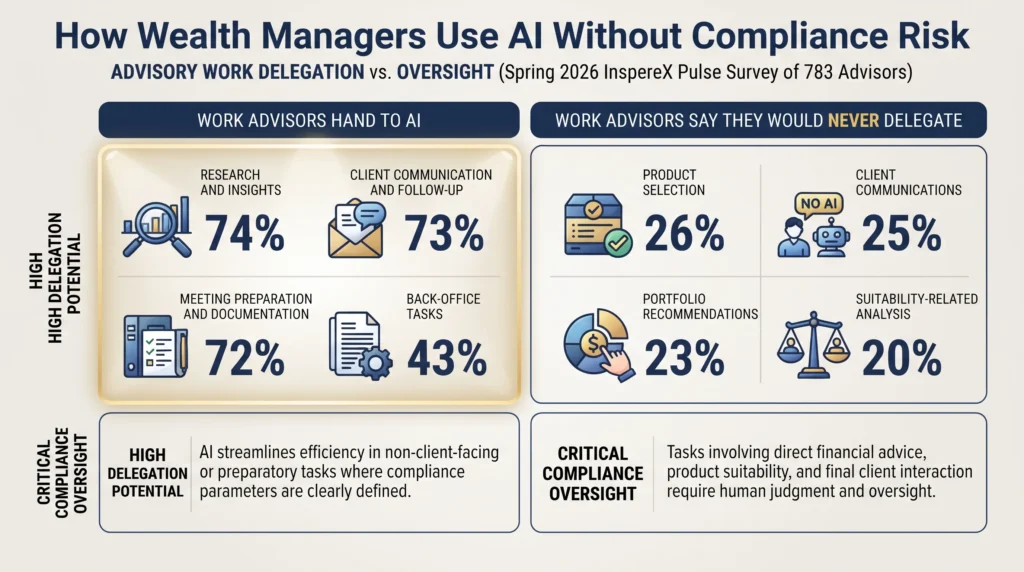
The line holds better written as a sentence than as a policy. Name the output that may reach a client unread, which in most firms is none. Name the output that needs a reader. Then name what nobody should make at all. The SEC’s examiners say firms now use these tools across research, drafting, client notes, advice and portfolio work, which is a wide span. Your own compliance team decides where your line falls.
What does supervision mean when software drafts?
The same thing it meant before: one named person answers for the output. The SEC Division of Examinations set out its fiscal 2027 priorities on 23 October 2026. It said it wants to know whether firms still meet what it calls “existing, technology-neutral obligations”. That paper is a staff view. Its own first page says it has no legal force and adds no new duties, so read it as a map of attention.
Technology-neutral is the phrase to keep. Nobody wrote a fresh rulebook for the chatbot, so the duties your firm already holds are the ones in play. A WilmerHale client alert of 26 October 2026 reads it the same way: a firm using these tools in advice or portfolio work should be ready to show how that fits the checks it runs today. Show is the working word, and change management is most of the effort.
What record should you keep of an AI draft?
Enough to rebuild the story: which tool made the draft, who asked for it, who read it, what they changed, and when it went out. Record keeping and reporting is one of the key areas in IOSCO’s final toolkit for AI use in capital markets, covered on 25 May 2026, beside governance, third-party risk and disclosure. Keep that record where your other client records live.
In practice this is one habit, not a new system. Save the final version in the client file as you always did. Then add a line on how the draft was made and who signed it. That line turns “we check everything” into something a reviewer can read. It settles arguments months later, when no one recalls whether a figure came from the tool or the custodian. Practical AI ends in a file somebody can read back.
Who signs off before a client sees it?
A named person, and the name counts more than the title. Clients assume someone is doing it. In Janus Henderson’s 2026 investor survey, reported on 5 June 2026, 85% expected their advisor to answer for AI output, and 79% would be upset if AI use was not disclosed to them. The practical form of that is a rule with one line per output type, naming the reader and what they read for.
Reading well is a skill, and it is not proofreading. The reader checks three things: that figures match the source, that nothing was invented, and that the tone fits this client. Open the source beside the draft, because a smooth draft hides a wrong number better than a rough one. The same survey found 40% would be upset to learn their advisor used AI to answer texts and email on its own, down from 44% in 2024.
AI Smart Ventures brings AI Consulting to that first sign-off talk, where a practice picks which output needs a reader and who that is. Bring the three drafts your team sends most.
What about AI inside tools you already run?
Treat it as a new tool, because that is what it is. A feature switched on inside your planning software, your client records or your meeting app reaches client data the moment somebody turns it on. Nobody buys it on purpose. The SEC’s examiners flagged firms’ growing use of outside providers and shared tech as an area of its own. So the real list of AI in your practice runs longer than the list you approved.
Start from the vendor side, not the tool side. Ask each platform you pay for which AI features are live, who can turn them on, and whether output is stored. Set that against the rule you wrote, then switch off whatever nobody will own. AI Smart Ventures observes that most practices find a feature running that no one chose. AI literacy starts with knowing what is switched on, and your own confidentiality rules govern what a vendor does with client data.
Which AI tool fits a practice like yours?
Usually the one inside software you run, since it comes with contracts and access controls you have had checked. There is no best AI tool for a practice. There is a best first task, and the tool follows from it. Pick the output your team makes most often, then test two tools on the same ten real jobs. Score them on how much editing each draft needed, and ignore the demo.
Judge the claims as closely as the output. When the SEC’s examiners review automated advice tools, they say the checks take in whether claims are fair and accurate, whether controls match what investors were told, and whether output fits investors’ profiles or stated plans. That is a useful shopping list well outside an exam. AI gurus with no operational depth head straight for the demo; your own held-back test set is what settles it.
Frequently Asked Questions
Can AI write advice for a client?
Not as output that reaches a client unread. A tool can draft a letter, build a research summary, or lay out options side by side. The call that an option suits this client stays with a person. Advisors say the same: in the Spring 2026 InspereX survey, 23% would never hand portfolio picks to AI and 20% said the same about suitability work.
When should a client be told AI touched their file?
Before it happens, not after. Then ask your own compliance team what form that notice takes where you work. Client views are not vague: the 2026 Janus Henderson investor survey found 79% would be upset if AI use was not disclosed, and 85% expect their advisor to answer for AI output. A short paragraph in your onboarding letter, naming what AI touches and who checks it, covers most of it.
What are advisors using AI for first?
Research and meeting work, in that order. In the Spring 2026 InspereX Pulse Survey of 783 advisors, 74% of AI users saw gains in research, 73% in client follow-up, and 72% in meeting prep and notes. Back-office tasks came last at 43%. The pattern holds across firms: work that ends in a draft someone was going to read anyway gets picked up first.
Where can you find honest peer accounts of AI use?
Start with your own professional body and its member groups, then with published surveys that name their sample. Peer forums are useful for the awkward details, such as which link broke last month, and they are not evidence. Look for the sample size, the field dates and who paid for the work. A figure with a method behind it beats a confident opinion.
How do you check a tool’s claims before you buy?
Test it on your own work first, then read the vendor’s claims against what you saw. Hold back ten real jobs the tool has never seen, run both tools through them, and count the edits each draft needed. The SEC’s examiners say reviews of automated advice tools take in whether claims are fair and accurate and whether controls match what investors were told.
Will AI replace wealth managers?
Unlikely, and the split of work is already visible. Advisors hand over drafting, summing up and prep, then keep product choice, suitability and the client bond. In the Spring 2026 InspereX survey, 70% use at least one AI tool while a quarter name client contact as work they would never hand over. The job that shrinks is the admin around advice.
What usually goes wrong first in a practice?
An unread draft reaching a client, nearly every time. It happens when the tool is fast, the week is busy, and nobody was ever named as the reader. Next most common is a feature switched on inside software you pay for, touching client data no one logged. Both have the same fix: one page naming allowed tools, the output each may make, and the reader for each.
How do you start with AI in a practice this quarter?
Pick one output and run it for a month. Scope drives the effort, not the tool: how many people are in scope, how much is built on your own templates, and how long the old way runs beside the new. One repeat output takes far fewer hours than a broad tool tour. Ask any AI advisory partner for named stages and a finish point. Schedule a consultation to scope that first output.
Executive Summary
AI for wealth management is admin work first: notes, summaries, drafts and document chasing. Most advisors run something, and the tasks they refuse to hand over sit around product choice, suitability and advice. The rules did not change for software, which is why examiners call the duties technology-neutral. So name a reader for every output that reaches a client. Keep one line in the file on how a draft was made and who signed it. Then audit the AI features already live inside your platforms, and tell clients before they ask.
What Should You Do Next?
This week, list every output your practice sends a client and mark the ones AI touches. Name one reader for each marked output, then write what that reader checks for in a single line. Ask each platform you pay for which AI features are live and who can switch them on.
AI Smart Ventures offers AI Consulting for growing businesses that need the review step settled before AI output reaches a client. Schedule a consultation to name a reader for each output and write the one-page rule.
People Also Read
- AI Predictive Maintenance: How It Works and Is It Worth It
- Microsoft Copilot Tips for Microsoft 365: Real Results
About the Author
Nicole A. Donnelly is the Founder of AI Smart Ventures and an AI Adoption Specialist with 20 years of experience as a founder and CEO and over a decade leading AI adoption initiatives. She helps businesses integrate artificial intelligence with clarity and confidence, driving innovation and sustainable growth. Nicole has trained over 20,217 professionals in Applied AI, delivered 624 workshops, and worked with close to 1,000 organizations across diverse industries.
Expertise: AI Transformation, AI Strategy, AI Implementation, AI Adoption, Applied AI, Marketing, Business Operations
Disclaimer: This content is for informational purposes only and does not constitute professional business or technology advice. Results vary based on industry, existing systems and implementation commitment. Contact AI Smart Ventures for a consultation regarding your specific situation.