The Owner-Operator’s Guide to AI Vendor Security and SOC 2 Compliance
AI can absolutely create real ROI. It can save time, tighten operations, improve decision-making, and help teams move faster. But here’s the part a lot of owner-operators learn too late: if you wire AI into your business insecurely, the downside is not theoretical. It can mean exposed customer data, leaked intellectual property, compliance headaches, and a vendor relationship you regret the minute legal gets involved.
That is why this conversation matters before you sign anything. If you’re evaluating an AI deployment partner, SOC 2 compliance AI standards, privacy guarantees, and real enterprise AI security practices are not nice-to-haves. They are table stakes. A slick demo is not proof. A confident sales pitch is not proof. And vague language about “taking security seriously” is definitely not proof.
The core premise of this guide is simple: secure AI adoption starts with disciplined vendor vetting. You need to know how to evaluate an AI partner’s compliance posture, what contractual protections to demand, and how to tell whether a consultant actually builds with secure-by-design principles or is just borrowing the language.

Introduction: The Hidden Risks of Enterprise AI Implementation
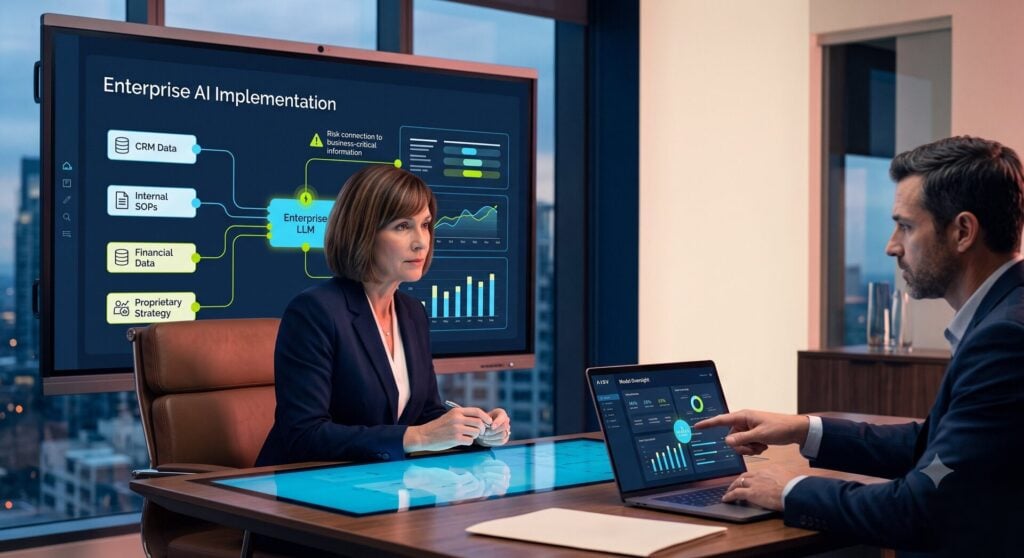
The hidden risk in AI adoption is that the most powerful use cases usually touch your most sensitive information. That means customer records, internal SOPs, financial data, contracts, HR documentation, support transcripts, proprietary strategy, and product knowledge. Large Language Models, or LLMs, become risky when businesses connect them to systems and data without clear guardrails for storage, access, retention, and model behavior.
There is also a big difference between experimenting with a public AI tool and deploying enterprise AI across your workflows. A public tool might help an employee draft a first pass at an email. An enterprise implementation might connect AI to your CRM, support desk, internal knowledge base, document systems, and analytics stack. At that point, you are no longer just using AI. You are creating a new layer in your operating environment, and that layer needs the same rigor you would expect from any other business-critical system.
If you’re the owner, operator, COO, or executive sponsor, the accountability still lands with you. Your vendor may handle the build, but your company owns the risk. Regulators, customers, and partners will not care that a third party caused the issue. They will care that your organization allowed sensitive data to be handled poorly. That is exactly why a strong AI vendor security questionnaire for owner-operators should be part of your process from day one.
Why SOC 2 Compliance and Privacy Guarantees Are Critical for AI Deployment
How critical is SOC 2 compliance when selecting an AI deployment partner for my company?
Very critical. SOC 2 is one of the clearest signals that a vendor has formal controls around how it handles systems and data. In practical terms, SOC 2 looks at whether a company has disciplined processes tied to security, availability, processing integrity, confidentiality, and privacy. For AI deployments, that matters because your vendor may be touching the exact systems and data you cannot afford to mishandle.
SOC 2 compliance AI standards do not guarantee perfection, but they do tell you the vendor has gone beyond improvisation. That means documented controls, role-based permissions, monitoring, incident response procedures, and repeatable internal processes. If a vendor cannot explain its controls clearly, or treats compliance like a checkbox instead of an operating discipline, that should slow you down.
This is especially important when the AI deployment partner will access proprietary material. Think pricing models, internal playbooks, customer communications, legal documentation, or regulated data. Without strong controls, you increase the risk of unauthorized access, accidental exposure, and IP leakage. A SOC 2 aligned partner reduces that risk because they are expected to manage access, track activity, and maintain a defensible operating environment.
What guarantees should I look for regarding data privacy when working with AI service vendors?
This is where owner-operators need to get very specific. Do not settle for broad promises. Ask for written contractual protections around AI vendor data privacy, including:
- Zero data retention policies where appropriate for prompts and outputs
- Explicit non-training clauses stating your proprietary data will not be used to train public or shared models
- Clear data ownership language confirming your company retains ownership of inputs, outputs, and connected data
- Defined subprocessors and disclosure of where data may flow
- Regional data residency terms when your legal or customer obligations require them
- Encryption in transit and at rest
- Breach notification timelines and incident response obligations
- Data deletion procedures at the end of the engagement
If you’re handling customer data, employee data, or regulated information, privacy is not just a technical preference. It can be a legal requirement. GDPR, sector rules, contractual obligations with your own clients, and internal governance standards all matter here. If you’re operating across borders, this gets even more important. AISV’s piece on data residency in AI contracts for Canadian and EU founders is a useful next read if that issue is on your desk right now.
A strong AI vendor should also be able to explain how compliance works in motion, not just on paper. Ask how they monitor access, how they log events, how they handle incidents, and how they review exceptions. Good vendors have answers ready. Weak vendors pivot back to marketing language.
How to Vet AI Consultants for Enterprise Security and Secure-by-Design Practices
How can I tell if an AI consultant really understands enterprise security and GDPR?
Start by asking questions that force operational answers. If you’re wondering how to vet an AI consultant, don’t ask whether they “care about security.” Ask how they actually build for it.
Questions worth asking include:
- How do you handle PII redaction before data reaches a model?
- What is your approach to regional data residency?
- How do you separate client environments and credentials?
- What is your policy on prompt and output logging?
- How do you enforce least-privilege access?
- How do you support GDPR rights like deletion, access, and data minimization?
- What subprocessors are involved in the solution?
- What happens if a model provider changes its retention or training policy?
A real enterprise-focused consultant will answer in plain English and then go deeper when needed. They should be able to explain what personal data is being touched, where it moves, who can access it, and how they reduce exposure. If they dodge those questions, or answer only at a high level, that’s a red flag.
How do I verify that an AI solutions provider builds with secure-by-design principles?
Secure-by-design means security is built into the architecture from day one. Not patched in later. Not added after the pilot. Not delegated to a future phase. A secure-by-design AI implementation requires encryption at rest, encryption in transit, RBAC, audit logging, clear environment separation, and contractual controls around retention and training.
Ask for proof, not promises. Request:
- Architectural diagrams showing where data enters, moves, and exits
- Data flow maps identifying every system, model, and connector involved
- Evidence of encryption standards in transit and at rest
- RBAC design showing who gets access to what
- Audit logging details for prompts, actions, and system events
- Redaction and filtering controls for sensitive data
- Incident response workflow and escalation process
This is also where technical case studies matter. You want examples of past deployments where the consultant had to work through privacy, governance, and system access challenges, not just automate a generic workflow. If they can show how they handled security constraints in a real implementation, you’re getting closer to a trustworthy answer.
RBAC matters because enterprise AI should never become a free-for-all. Finance should not automatically see HR data. Contractors should not automatically access your full knowledge base. Audit logging matters because if something goes wrong, you need a record of who accessed what, when, and how. If a vendor cannot explain these controls clearly, they are not ready for enterprise deployment.
Reference checks should also include security questions. Don’t just ask, “Were they good to work with?” Ask:
- Did they document your data flows?
- Did they push back on risky requests?
- Did they help your internal team understand compliance implications?
- Did they leave you with a more secure operating model than you started with?
If you want a broader framework for this process, AISV’s guides on how to de-risk your AI investment and choosing an AI implementation partner are strong complements here.
Finding the Best AI Consulting Partners for Secure Enterprise Adoption
Best AI consulting companies that strictly follow SOC 2 compliant methodologies?
The best AI consulting companies do not lead with hype. They lead with method, controls, and business outcomes. They can explain how they assess use cases, how they govern data, how they reduce implementation risk, and how they prepare your team to use AI responsibly after the build is done.
When you’re comparing firms, look for a few distinguishing traits:
| What to Look For | Why It Matters |
| Transparent methodology | You can see how strategy, security, and implementation connect |
| Operational experience | They understand real workflow constraints, not just demos |
| Compliance fluency | They can discuss SOC 2, GDPR, and enterprise controls clearly |
| Training capability | Your team adoption improves, and risky usage drops |
| Advisory support | Governance does not stop after launch |
That is why the strongest partners usually offer more than implementation alone. They also provide advisory and training. Ongoing governance questions will come up. Your team will need guardrails. New vendors will enter the stack. Policies will need refinement. A firm that can support AI Advisory and secure rollout planning through AI Implementation is far more useful than a shop that just builds and disappears.
Best firms for navigating enterprise data privacy and security when adopting AI?
The best firms for enterprise AI security are the ones that map your actual workflows before they recommend tools. They do not force generic integrations into sensitive environments. They ask what data is involved, what systems are touched, what compliance obligations apply, and what internal capabilities your team has to manage the solution safely.
That is where AI Smart Ventures stands out. AISV is built around practical AI adoption, measurable business value, and a secure-by-design mindset. The team works with leaders who want more than experimentation. They want a roadmap, implementation support, team upskilling, and guidance strong enough to hold up in regulated or high-stakes environments. In other words, AISV helps bridge the gap between cutting-edge AI and the enterprise discipline required to use it responsibly.
If security is already becoming a board-level or client-facing issue in your business, you may also want to review The Business Leader’s Guide to Secure AI and understand whether an AI red team test belongs in your future-state governance model.
Next Steps: Securing Your AI Roadmap with AI Smart Ventures
If you take one thing from this guide, let it be this: SOC 2, secure-by-design architecture, and rigorous vendor vetting are not optional if your AI systems touch meaningful business data. Before you sign an AI contract, you need clarity on privacy guarantees, retention policies, model training restrictions, access controls, audit logging, and the consultant’s actual depth in enterprise security.
AI Smart Ventures helps businesses move from scattered AI ideas to secure, compliant execution. That means practical roadmaps, smart vendor decisions, and implementation support grounded in real business outcomes, not buzzwords. Ready to transform your business securely? Book a tailored consultation with AI Smart Ventures to build a secure, compliant, and highly profitable AI roadmap.