What AI Consultants Charge For, and What Sizes a Job
Last Updated: November 2026
How much AI consultants charge is decided by scope, and the scope is mostly a fact about your business. You pay for judgment about which task to change first, the order the work runs in, the checking that follows, and for someone who has done this before. Two quotes with the same words on the front page can describe very different jobs, so the useful question is what makes a job big.
AI Smart Ventures has guided growing businesses through AI adoption at the moment a quote lands and nobody can tell if the job is big or small. Owners who buy well have worked out what makes their own job hard. That list, not the total, is what a quote is really answering.
Skip that work, and you will compare two quotes on the only thing they share: the total. The bigger risk is quieter: you buy a job sized for a firm whose records are tidier than yours.
Key Takeaways
- You buy judgment and sequence: which task changes first, what order the steps run in, and the review around each output. The risk of a wrong design sits in there too.
- Your records set the size before anyone quotes: only 5% of 515 US AI decision-makers called their data largely ready for AI. That finding comes from Further’s 2026 research.
- Count the systems the work must reach: 96% of agentic AI uses need to connect to systems already in place. That is from an Omdia survey of 300 IT and AI leaders run for Boomi.
- People carry the hours, not the software: 80% of firms name automating routine tasks as a main AI goal, while 35% put reskilling first. That contrast is from Aon’s inaugural Human Capital Trends Study, released in April 2026.
- An unwritten process is extra scope: fewer than 20% had the groundwork for the AI work they planned. GBTEC research asked 600 senior business and operations leaders.
Notice that four of the five describe your business, not the consultant’s. A wish for operational efficiency cannot be sized; a named workflow can. Enough AI literacy to describe your own problem is worth more here than any list of tool names.
What do AI consultants charge for, exactly?
Four things, and only one of them looks like work. Judgment about which task to change first and what finished means, then the sequence, so the second step does not undo the first. The review that follows each output, with a named person on it, and the risk they carry if the design is wrong. Hours are how some firms measure those four, but they are not what you are buying.
The fifth thing is harder to name and often worth the most: pattern memory. A firm that has run this workflow in eleven other firms knows which step breaks, so you buy the chance to skip that search. Ask each candidate how many times they have done this exact thing, and what went wrong last time. A boutique firm with real AI consulting history answers in specifics. Generic AI consultants answer in groups, because the specifics are not there.
Which conditions make a job big or small?
Six things, and you can score your own before anyone visits: how messy your records are, how many systems the work must reach into, and how many people have to change how they work. Then, whether one person can decide and reply fast, whether the process is written down anywhere, and how much of the work your own team can take on. Each one you fix in advance shrinks the job you are quoted for.
The last two are the ones owners miss. GBTEC research with 600 senior business and operations leaders found 78% planned major AI work within two years. Fewer than 20% had the operational foundation to run it. An unwritten process is not a small gap: someone must write it down before anything can be built on it, and that someone is billed. Capability building cuts the other way: hours you keep are hours you do not buy.
| Condition | Points to a small job | Points to a large job |
|---|---|---|
| your records | one system, fields agree | two systems that clash |
| people affected | one team, same tasks | several teams, new steps |
| the decision | one owner, replies in days | a board that meets monthly |
| the process | written down and current | held in two people’s heads |
| your own hours | a few each week, available | nobody free before next quarter |
How does your own data change the size?
More than any other single factor. Work that reads clean, current records is a short job. Work that must first match up two systems and guess which field is true is a long one. In Further’s 2026 research of 515 US AI decision-makers, 5% said their data was largely ready for AI. And 29% had run a formal data audit with a plan to fix what it found.
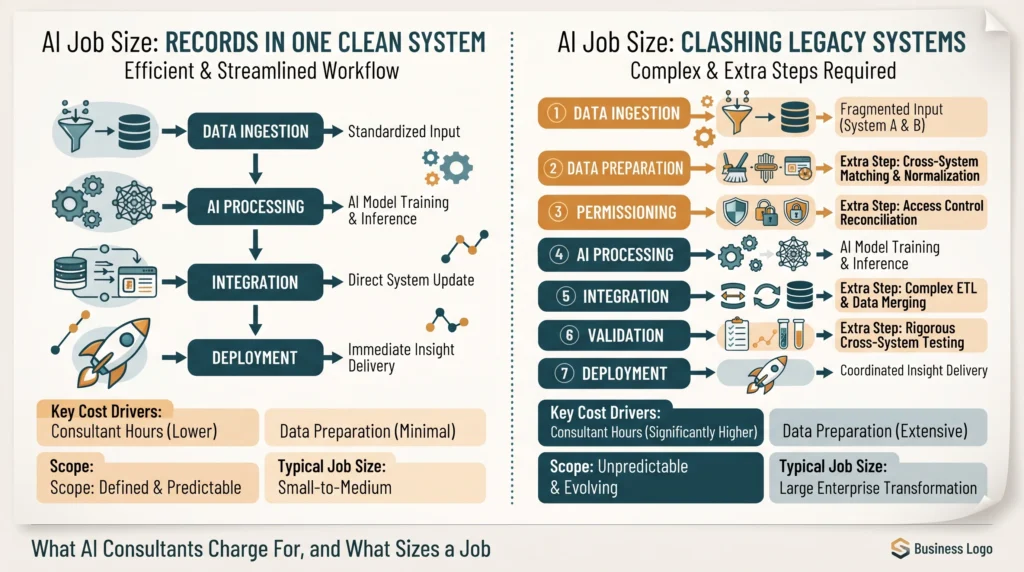
Systems count too, and the number is often higher than owners think. An Omdia survey of 300 IT and AI leaders in five countries, run for Boomi in May 2026, found 96% of agentic AI uses need to connect to systems the business already runs, and about 30% were stalled on exactly that. Each extra system adds an owner, a permission and a test, so workflow optimization is a smaller job inside one system.
How are AI engagements usually shaped?
Three shapes, and the names matter less than the end point. A bounded first stage buys a decision: a few weeks, one workflow, a written answer you could hand to another firm. A fixed scope buys a named result by a named date. A staged commitment buys the first stage and holds the second behind a gate you control. Ask which shape you are offered before you look at anything else.
The gate is the part worth arguing for, because AI projects do get stopped. Further’s research found 37% of those leaders had paused, scaled back or dropped an AI project that was not paying off. Poor or missing data was the reason named most among them, at 24%. A gate turns that into a choice you make on evidence. Without one, the stop happens anyway, only later, after more of the work is done.
AI Advisory sizes that first stage with you: one workflow, one named end point, and the gate that decides whether a second stage happens at all.
What should you ask to size the job yourself?
Five questions, and you can send them by email before any meeting. Which of my systems does this touch? How many of my people change how they work, and when? What do you need from us, and by which date? What is the first stage, and what does it end with? And what would make you pause? The answers size the job better than any total.
Send the same five to every firm and read the differences, not the totals. One will name four systems where another named one, and that gap is the whole argument. Watch for the firm that answers the people question with a single training day; change management runs for months, not for one afternoon. Research across growing businesses shows that owners who send those five in writing stop comparing totals and start comparing scopes.
Frequently Asked Questions
How does a consultant work out the size of your job?
By counting the unknowns, not the hours. A scoping call is really a count: how many systems, how many people, how clean the records are, who signs off and how fast. Each unknown turns into either a question in the proposal or a padded stage, which is why a firm that quotes without asking is quoting an average business, and yours is not average.
When is a quote reasonable for the job described?
When the work it describes matches the facts in your business. Reasonable means the scope fits the setup, so the same quote can be fair for a firm with one tidy system and absurd for a firm with four and no written process. Judge it by asking what it assumes about you, and if those guesses are wrong, the number was never the problem.
Is outside help on AI worth buying at all?
Usually yes for the first workflow, and less often after that. What you buy early is time: a firm that has done this before skips the months you would spend learning which step breaks. Aon’s 2026 study found 73% of firms have already deployed or are piloting AI, so the question is rarely whether, but how much help and for how long.
What makes a job grow after the work starts?
Three things, most common first. Records that turn out not to match, which nobody could see from outside, and a second system the first one quietly leans on. Then a group of people who were never told their work was changing. None of those surprises a firm that has done it before, and they are why a first stage should be short enough to find them.
Can you make the job smaller before you buy?
Yes, and it is the only lever fully in your hands. Pick one workflow instead of three, export your records and read them yourself, so you learn which fields clash. Name one approver with a reply time, and agree to run the new process yourself once the firm leaves. Each of those removes an unknown, and unknowns are what a firm sizes for.
What explains a wide gap between two quotes?
Different amounts of doubt, built into different scopes. One firm assumed your records are usable and your approver replies fast; the other assumed neither, though both may be honest about the job they pictured. Line them up by what each says it will touch, who it needs from you and when it ends, and the gap usually turns out to be scope rather than skill.
What should a first stage be allowed to produce?
One decision, written so another firm could act on it. That means a named workflow, a measure taken against today’s baseline, and a plain answer on whether to go on. A first stage that ends in a slide deck has produced an opinion, so keep it to a few weeks, since a bounded stage stops being a test once it runs long enough to become the job.
Does a longer engagement mean a bigger job?
Not always, and the two come apart more often than you expect. A long job can be a thin AI advisory tie with one call a month, while a short one can be a heavy AI implementation that changes four teams in six weeks. Weight lives in the people and systems touched, not in the calendar, so ask how many hours a week your staff will spend.
Who on your side has to be available, and when?
One person who can decide and one who does the work, both from week one. The decider answers scope questions inside a stated number of working days, while the other shows the consultant what really happens, including the steps nobody wrote down. An Omdia survey for Boomi found C-suite leaders personally involved in choosing use cases at 75% of firms, which is a workload, not a favor.
How do you tell a strategy job from a build job?
By what each one hands over. An AI strategy job ends in a written decision: which workflow, in what order, measured how. A build job ends in something running inside your systems with a trained person beside it. Strategy stages are short and should stay that way, while build stages carry the wiring and the AI upskilling, which is where most of the weight sits.
What is the first thing to do with a quote you hold?
Turn it into conditions before you compare it to anything. Write down which systems it assumes, how many of your people it changes, what it needs from you and when it stops, then mark the lines you cannot check, because those are the real size of the job. Schedule a consultation with AI Smart Ventures to test a quote you hold against your own facts.
Executive Summary
What AI consultants charge for is judgment, sequence, review and the risk of being wrong, with pattern memory from jobs like yours underneath. What sizes the job is mostly your own setup: messy records, the systems touched, and the people who must change how they work. Three more count: whether one person can decide fast, whether the process is written down, and how much your team can do itself. Jobs come in three shapes: a bounded first stage, a fixed scope with a named end point, or a staged commitment behind a gate. Ask the five questions in writing and compare scopes, not totals.
What Should You Do Next?
This week, score your own job on the six things and write the answers down. Pull one data export and read it, count the systems the work must touch, and name the one person who can decide. Then send the same five questions to every firm you are talking to, and give them a date for the reply.
AI Smart Ventures offers AI Advisory for growing businesses trying to tell a big AI job from a small one. Schedule a consultation to put a count of weeks and a named end point around your first stage.
People Also Read
- What Belongs in an AI Acceptable Use Policy? A Checklist
- AI Tool Comparison: What Actually Separates Them in 2026
About the Author
Nicole A. Donnelly is the Founder of AI Smart Ventures and an AI Adoption Specialist with 20 years of experience as a founder and CEO and over a decade leading AI adoption initiatives. She helps businesses integrate artificial intelligence with clarity and confidence, driving innovation and sustainable growth. Nicole has trained over 20,217 professionals in Applied AI, delivered 624 workshops, and worked with close to 1,000 organizations across diverse industries.
Expertise: AI Transformation, AI Strategy, AI Implementation, AI Adoption, Applied AI, Marketing, Business Operations
Disclaimer: This content is for informational purposes only and does not constitute professional business or technology advice. Results vary based on industry, existing systems and implementation commitment. Contact AI Smart Ventures for a consultation regarding your specific situation.