
What Security Standards Should You Demand From an AI Agency? A Vendor Evaluation Guide
The Stakes of AI Security for Owner-Operated Businesses
AI can absolutely change how an owner-operated business runs. It can speed up operations, tighten reporting, improve customer response times, and help your marketing team produce more without adding headcount. That part is real. But so is the risk. The same AI system that saves your team hours can also expose customer data, leak internal knowledge, or create a compliance problem you did not know you had until it is expensive.
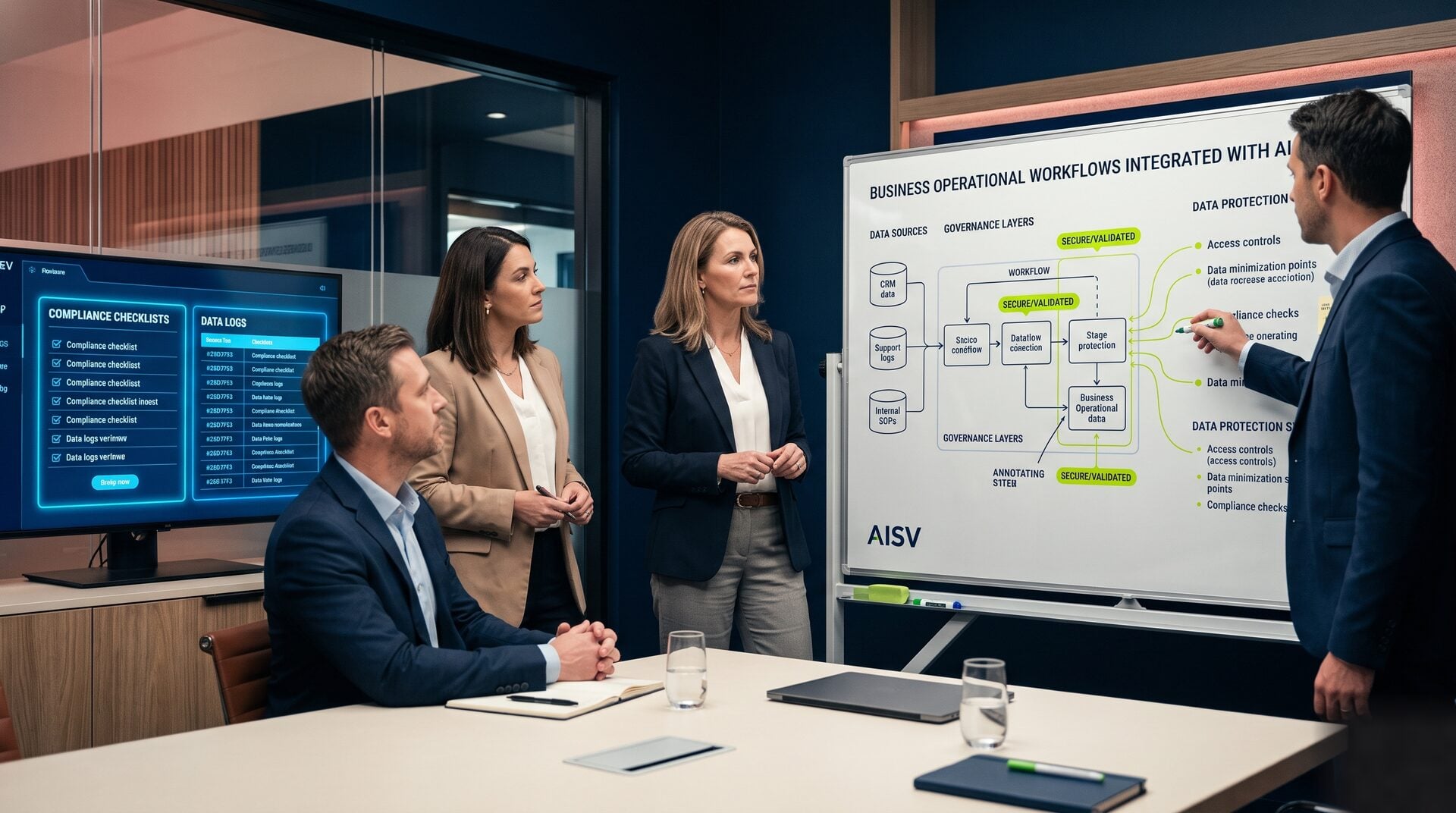
That is why AI agency security standards cannot be treated like a nice extra. If a vendor is touching your CRM data, support logs, financial workflows, HR documents, or internal SOPs, they are not just helping you automate. They are stepping into your risk environment. For owner-led businesses, that matters even more because one bad vendor decision can create operational disruption, reputational damage, and legal headaches all at once.
Here is the practical truth: not every AI agency that sounds smart is security-mature. Some are great at demos and weak at governance. Some know prompting but not enterprise-grade AI security. Some can build fast but cannot explain how they protect your data. This AI vendor evaluation guide is here to help you separate real capability from polished language so you can move forward with confidence, not crossed fingers.
Recognizing True Enterprise-Grade Security Competence in AI Vendors
How can I tell if an AI agency knows what they are doing with enterprise-grade security? Start by ignoring broad claims like “we take security seriously” and move straight to evidence. A credible partner should be able to explain, in plain language, how they protect data in transit and at rest, how they segment client environments, and whether the large language model tools they use support LLM zero-retention or equivalent no-training settings.
If they get vague when you ask those questions, that is your signal.
A security-mature AI partner should be comfortable discussing standards like:
- Encryption in transit using modern transport security
- Encryption at rest for stored files, logs, and databases
- Zero-retention or no-training settings for model providers where available
- Role-based access controls for both vendor staff and your internal users
- Environment separation between client systems and test systems
- Incident response procedures if something goes wrong
What security standards should I demand from a company building AI solutions for us? At a minimum, ask how their work aligns with recognized frameworks such as ISO 27001 and the NIST AI Risk Management Framework. They do not need to drown you in jargon. But they should be able to show that their process is structured, repeatable, and based on accepted security practices rather than improvised project habits.
You also want to understand how they manage people risk, because most data exposure issues are not caused by flashy hacks. They are caused by bad access hygiene, weak internal controls, and teams handling sensitive information casually. Ask:
- Who on your team can access client data?
- How is access approved, reviewed, and removed?
- What employee security training do you require?
- How do you prevent proprietary data from being pasted into public tools?
- What is your policy on subcontractors or freelancers touching client environments?
A strong firm will have direct answers. A weak one will talk around the question.
Just as important, request proof of active security maintenance. That means regular penetration testing, vulnerability assessments, patching practices, and documented remediation workflows. Security is not a one-time setup. It is an operating discipline. If an agency cannot show how it finds and fixes weaknesses over time, you are not looking at enterprise-grade AI security. You are looking at hope.
Finally, ask for examples of safe deployment in regulated or sensitive environments. You do not need confidential client details. You do need evidence that the firm has worked where mistakes are costly. That is one reason businesses often look for a partner with a clear point of view on governance, implementation, and risk. If you want a broader framework for those conversations, this guide on what you should ask an AI vendor is a useful next step, and so is this piece on how to compare AI consulting firms for strategy, implementation, and training.

AI Vendor Security Checklist
Use this as a quick screen during vendor interviews:
- Can they explain encryption at rest and in transit clearly?
- Do they use LLM zero-retention or no-training configurations where possible?
- Do they align with ISO 27001 and the NIST AI Risk Management Framework?
- Do they enforce internal access controls and staff security training?
- Can they show recent penetration testing or vulnerability assessment practices?
- Do they have experience in regulated or sensitive environments?
- Can they explain exactly what happens to your data, prompts, outputs, and logs?
If you cannot get clean answers to these seven points, keep looking.
Securing Your Data: Privacy Guarantees and Framework Compliance
How do we make sure our AI implementation is GDPR and SOC 2 compliant? You do it by treating compliance as an architectural decision, not a legal afterthought. If you wait until the build is nearly done to ask about privacy, you are already late. Your AI consulting partner should design the workflow, data handling, permissions, and logging structure around compliance from day one.
Start with SOC 2 Type II. If a vendor is handling business-critical systems or sensitive information, ask whether both the consulting firm and the underlying third-party providers they rely on meet this standard. That includes model providers, automation platforms, cloud hosts, and any tool that stores or processes your business data. A SOC 2 compliant AI implementation is only as strong as the weakest vendor in the chain.
Then get specific in the contract.
What guarantees should I look for regarding data privacy when working with AI vendors? At minimum, you want written language covering:
- Your proprietary data is not used to train public foundation models
- Data ownership remains with your business
- Access is limited to authorized personnel only
- Data retention periods are defined
- Data deletion procedures are documented
- Breach notification timelines are clear
- Subprocessor use is disclosed and controlled
This is where many businesses get caught. They assume a vendor’s default settings are safe. Sometimes they are not. If your team is unsure what should never enter an AI workflow in the first place, read what you should never put into an AI tool and how to keep client data safe when using AI.
For GDPR AI data privacy, the right partner should be building around core principles such as:
- Data minimization: only use the data required for the task
- Purpose limitation: do not reuse data beyond the agreed use case
- Access control: restrict who can view, change, or export data
- Explainability: maintain clarity around how outputs are generated and used
- Deletion rights: support workflows tied to the right to erasure or “Right to be Forgotten”
That last point matters more than many teams realize. If a customer asks to have their data deleted, can your AI workflow actually support that? If the answer is “we think so,” that is not good enough.
You should also insist on robust auditability. That means logs showing who accessed what, when prompts were run, what systems were involved, and how AI-generated outputs moved through the workflow. Strong audit trails are not just for regulators. They are how you troubleshoot, defend decisions, and keep control as adoption scales.
And inside any custom system, insist on role-based access control (RBAC). Not everyone on your team should see the same data, trigger the same automations, or access the same AI-generated insights. Good implementation partners build those permissions into the product from the beginning. If you are evaluating a delivery partner for this stage, review the difference between an AI consultant, an AI agency, and an AI implementation partner and AI governance framework guidance for businesses.
Navigating North American Compliance: Why Cross-Border Knowledge Matters
What factors should I consider when choosing an AI partner for North American compliance? Start with this: North America is not one compliance environment. The US is fragmented, with state-level privacy rules that can vary meaningfully. Canada has federal privacy obligations under PIPEDA, plus sector-specific and provincial considerations. If your AI vendor treats “North American AI compliance” like one generic box to check, they are not ready.
This is where data residency and hosting choices matter. If your business serves customers across borders, ask where data is stored, where it is processed, and whether localized hosting options exist. Cloud AI services often move fast, but cross-border data movement still has legal and contractual consequences. A capable vendor should be able to explain those mechanics clearly, including how they handle subprocessors and cross-border transfers.
How important is it that my AI consulting partner is familiar with both US and Canadian data laws? Very. If your operations, customers, or employees touch both countries, dual familiarity reduces risk in practical ways. It affects consent language, retention decisions, vendor contracts, residency choices, and how you respond if a regulator or customer asks questions later. A partner who only understands one side of the border can design a system that works technically but creates compliance friction operationally.
That is also why future-proofing matters. Regulations will keep moving. The right partner does not just build for today’s rules. They build adaptable, compliance-first architecture so your workflows can evolve without being rebuilt from scratch. If you are already thinking about long-term risk, this article on the real AI privacy risks at work in 2026 is worth your time.
Choosing the Right AI Partner for Secure, Scalable Growth
If you remember only one thing from this AI vendor evaluation guide, let it be this: security maturity is not separate from AI success. It is part of AI success. The right partner should be able to show you real AI agency security standards, clear privacy guarantees, and practical experience with cross-border compliance. You are looking for a team that can handle enterprise-grade AI security, design a SOC 2 compliant AI implementation, support GDPR AI data privacy, and navigate North American AI compliance without turning your project into a compliance guessing game.
That is the kind of work AI Smart Ventures is built for. AI Smart Ventures helps businesses move from scattered AI experimentation to secure, practical implementation with strategy, governance, training, and delivery aligned from the start. Practical AI for SMBs requires a partner who understands both the technology and the risk environment. The right AI consulting firm should be able to show you exactly how they protect your business while delivering measurable results. Ready to transform your business with AI without compromising your data? Book a tailored consultation with AI Smart Ventures today to build a secure, practical roadmap for real results.