AI Certifications vs. Applied Business AI Training: What Owner-Operators Need to Know Before Enrolling Their Team
AI Certifications vs. Applied Business AI Training: What Owner-Operators Need to Know
If you are an owner-operator trying to make smart decisions about AI, you are probably seeing the same thing everyone else is seeing right now: a flood of courses, certifications, bootcamps, and vendor-led training programs all promising to future-proof your team. On paper, it looks like progress. In practice, it is easy to spend money, collect certificates, and still have no real change inside the business.
That is the dilemma. Do you send your team into big-name AI certifications that look impressive on LinkedIn, or do you invest in applied AI business courses that help people use AI inside actual workflows this month, not someday? For most businesses, that is not an academic question. It is an ROI question.
This article breaks down the difference between AI certifications and practical business training, what an effective AI course for business should include, who offers the strongest workplace upskilling options, and how to think about training if your goal is bigger than individual learning and includes building an internal AI task force or AI center of excellence.
The AI Skills Gap: Why Theoretical Knowledge Isn’t Translating to Business ROI
The AI skills gap exists because tools are moving faster than teams can absorb them. New platforms show up every week. Features change constantly. Leaders buy software hoping productivity will jump, but employees are often left with a login, a vague policy, and no real process for using the tool safely or well.
That is why “just play around with ChatGPT” is not a strategy. It can create isolated wins, but it rarely creates secure, repeatable business outcomes. Without structure, teams prompt inconsistently, expose sensitive information, duplicate effort, and produce outputs that still need heavy cleanup. You get activity, not transformation.
The cost of that gap is bigger than most companies realize. It shows up as wasted software spend, stalled adoption, inconsistent quality, and leadership teams that cannot prove AI ROI. The fix is structured, outcome-based education. Your team does not need more hype. They need a training path that connects AI use to cost-to-serve, speed, margin, capacity, and measurable business value.

Comparing Generic AI Certifications vs. Practical Applied AI Business Courses
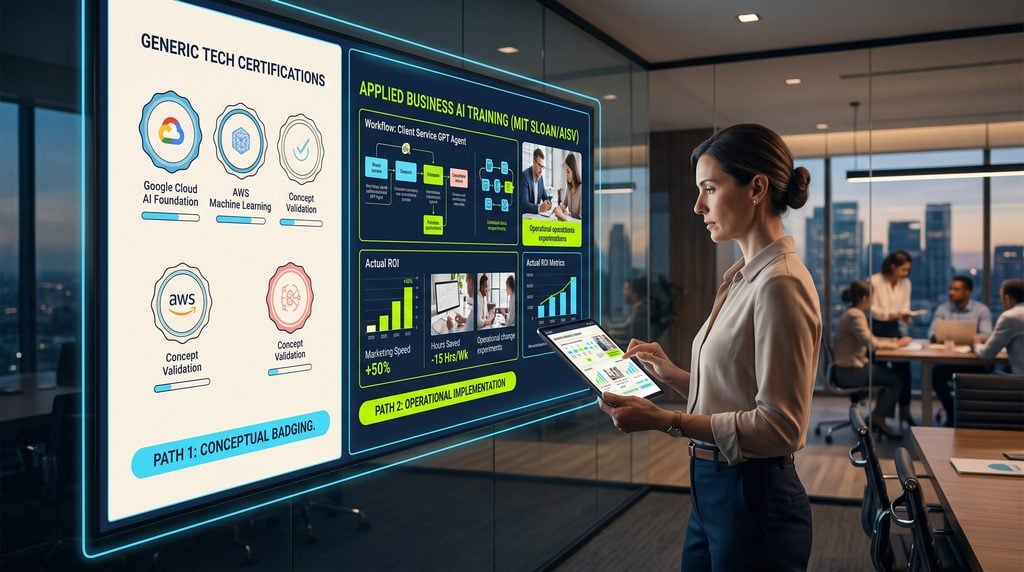
The clearest way to compare AI certifications and applied AI business courses is this: generic certifications usually teach people about AI, while applied business training teaches people how to use AI at work.
Big tech AI certifications often focus on cloud platforms, machine learning concepts, model development, data pipelines, engineering workflows, or product-specific ecosystems. That can be valuable if you are training developers, data scientists, or technical architects. It is much less useful if the people you need to train are in operations, marketing, HR, sales, customer service, or leadership.
Applied business AI training is different by design. It focuses on prompt engineering for business tasks, workflow mapping, AI-assisted research and writing, process automation, internal knowledge systems, governance basics, and practical tool use inside real roles. The goal is not to turn your team into AI engineers. The goal is to make them more effective, faster, and more confident in the work they already own.
Here is the direct comparison:
| Criteria | Big Tech AI Certifications | Applied Business AI Training |
|---|---|---|
| Primary Audience | Developers, engineers, technical specialists | Business teams, operators, managers, leaders |
| Main Focus | Models, cloud tools, technical architecture | Workflows, productivity, automation, ROI |
| Learning Style | Technical modules, platform-specific content | Hands-on use cases tied to real business work |
| Best For | Building technical AI infrastructure | Improving day-to-day execution across teams |
| Time-to-Value | Often longer | Usually faster |
| ROI Measurement | Harder for non-technical roles | Easier to tie to time savings and output |
| Change Adoption | Often indirect | Built into the training process |
| Fit for SMBs | Sometimes too technical or abstract | Usually much better aligned |
For owner-operators, the pros and cons are pretty straightforward. Certifications can signal credibility, help technical hires deepen expertise, and support enterprise platform adoption. But they can also become vanity credentials if they are disconnected from how your business actually runs.
Applied courses usually deliver faster operational value. Your team learns on real tasks, in real tools, with real constraints. That is why, for roughly 95 percent of business roles, applied AI business courses beat generic AI certifications on speed, adoption, and measurable ROI. If you want a deeper framework for evaluating outcomes, this practical guide on how to evaluate whether an AI training program will actually deliver business results is a useful next read.
What to Look for in an Effective Business AI Course and Training Program
A strong AI course for business should help people do better work, not just understand terminology. That means the course needs to be hands-on, role-specific, and tied to actual workflows. If your team finishes training but still does not know where AI fits into their week, the program missed the mark.
The best corporate AI training programs usually include a few non-negotiables:
- Hands-on exercises using real job scenarios
- Clear data privacy and confidentiality guardrails
- Tool-agnostic frameworks so your team is not trapped in one platform
- Practical prompting methods that improve output quality
- Workflow analysis to identify where AI saves time or reduces friction
- Change management support so adoption actually sticks
This is also where customized AI training matters. A generic course may teach useful concepts, but your team needs translation into your business. Marketing has different needs than HR. Operations needs different automations than sales. If you want training that lands, it has to map to the work people are already doing. That is why role-specific programs tend to outperform broad awareness sessions. AISV has written in detail about this in The Ultimate Guide to Role-Specific AI Training.
Framework-driven programs are especially valuable because they help teams move from scattered experimentation into process design. A good example is an approach like AI Your Ops, where teams map workflows, identify repetitive tasks, and build automations around actual bottlenecks. That kind of AI training creates momentum because people can see the before and after clearly. If you want training that keeps working after the workshop, this breakdown of how to run AI training that sticks is worth reviewing.
Who Offers the Most Comprehensive Upskilling Courses for Applied AI in the Workplace?
The market breaks into three broad groups: MOOCs and self-paced platforms, bootcamps, and specialized consultancies. MOOCs are accessible and inexpensive, but they are often broad, passive, and disconnected from your workflows. Bootcamps can be more structured, but many still lean technical or focus more on completion than implementation.
Specialized consultancies tend to be stronger for workplace upskilling because they connect learning to business execution. That matters a lot. If your goal is team upskilling inside a live business, you need more than content delivery. You need practical examples, guidance on tool selection, governance guardrails, and support after the training session ends.
That is where a firm like AI Smart Ventures stands out. AISV is built around applied adoption, not theory for theory’s sake. Programs like Applied AI Course Level 1 are designed to help professionals use AI in real work, with hands-on projects, repeatable prompting frameworks, and practical business use cases. It is a guided path from curiosity to capability, which is exactly what most owner-operators need when they are trying to get traction quickly.
When you evaluate providers, look for these signals:
- Training tied to real workflows, not just general education
- Ongoing advisory or post-training support
- Practical governance and security guidance
- Ability to customize by role or department
- A clear path from learning to implementation
If you are comparing options, this article on why specialized consultancies outperform enterprise giants for SMB AI adoption gives a helpful lens.
Best Training Programs for Building an Internal AI Task Force or Center of Excellence
An internal AI task force, or AI center of excellence, is a cross-functional group responsible for guiding adoption, setting standards, evaluating tools, and helping the business scale AI responsibly. Mid-size and larger companies often need this because once AI use spreads across departments, ad hoc experimentation becomes messy fast.
Training for that group needs to go beyond basic AI literacy. A center of excellence needs workflow mapping, governance, security awareness, vendor evaluation skills, prompt standards, use case prioritization, and a way to measure outcomes across teams. In other words, this is not just AI training. It is operating model training.
The best programs for building an internal AI task force usually combine three layers. First, broad team upskilling so departments understand the basics. Second, advanced workshops for internal champions who will lead implementation. Third, ongoing advisory so the group can make smart decisions as tools, risks, and priorities change. This is also where train-the-trainer models work well. You create internal AI champions who can coach others, reinforce standards, and keep momentum alive.
For many organizations, the strongest path is a mix of practitioner-led workshops plus ongoing support. That is often more effective than trying to build a center of excellence from a static course alone. If your team is deciding how much to build internally versus how much outside support to bring in, Build Internal AI Capability vs. Hire External Expertise is a practical place to start. And if adoption is lagging even after training, Employee AI Adoption When Training Alone Isn’t Working can help you diagnose what is missing.
Making the Right Investment for Your Team’s AI Journey
If you strip away the noise, the decision gets simpler. Generic AI certifications are best when you need technical depth for technical roles. Applied business AI training is best when you need your team to improve how the business actually runs. One builds credentials. The other builds capability.
For most owner-operators, the real goal is not to say the team is AI-trained. The real goal is measurable AI ROI: faster execution, lower cost-to-serve, stronger output, better decisions, and more capacity without adding unnecessary complexity. That means your first step should be an honest audit of how your team is already using AI, where the workflow friction lives, and which roles would benefit most from structured upskilling.
Ready to turn AI into measurable ROI? Book a tailored consultation with AI Smart Ventures to explore our Applied AI Courses and build a custom training roadmap for your team. If you want practitioner-led guidance instead of more scattered experimentation, start there.