How Can a Veterinary Practice Use AI? Start With Notes
Last Updated: October 2026
Veterinary AI is software that writes. It turns what a vet says after an exam into a draft note, pulls a summary out of a long file, or drafts take-home text for an owner. It is not one product, and the best place to put it first is the plainest: each visit already ends in a record the vet writes, reads and signs. That last step is what makes notes a safe start.
AI Smart Ventures has guided growing businesses through AI adoption inside owner-run practices, where one person holds the schedule, the staff rota and the charts at once. AI Smart Ventures observes that practices starting with the note tend to keep going, because the check was part of the job before.
Get that order wrong, and the cost hides for months. A note nobody read goes into a legal file, and it stays there.
Key Takeaways
- Start with the note the vet reads anyway: the check sits in the working day, so no new habit is needed.
- Specialists ranked notes first: a January 2026 survey in JVIM put doctor’s notes and records top of the list, first for 60% of the ACVIM members who replied.
- Errors are the named risk: in that survey, generating or perpetuating errors was the top-ranked worry, for 39% of those ACVIM members.
- The record says a tool helped: AAVSB model language asks that AI help in making or changing a record be written into the record.
- Closed beats open: the AAVSB rates a note-writing tool inside a closed, secure system low risk, and the same tool wired to an open AI system high.
- The clinical call does not move: reading images and calling the finding stays with the vet, whatever a tool offers.
Those six point at one choice, not a shopping list. The first AI question in a practice is which piece of writing a machine may start, and who signs it. Notes win that test because the signing happens now. Each other job has to earn a check step from scratch.
Why start with the notes a vet dictates?
Because the check is there now. Each visit ends in a record the vet writes, reads and signs. A drafted note walks into a review that exists, rather than needing a new one. The tool takes the dictation or the exam room audio. It gives back a first draft in your usual format, and the vet edits and signs. Nothing about the care changes. Only the typing moves.
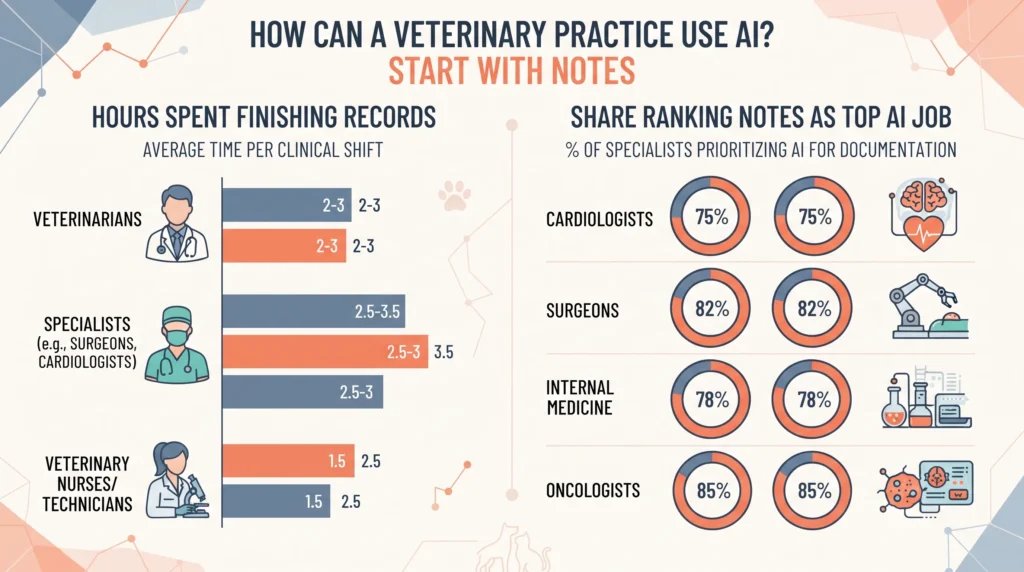
Where the hours go is less of a mystery than it looks. dvm360 reported a survey of 151 relief vets in April 2026, in which 66.2% said they spend two to four hours a shift finishing records. Relief work is its own slice of the field, so read that as a signal and not a census. The shape holds: writing is a repeated block of the day, and it gets read before filing.
Which AI job do veterinary specialists rank first?
Notes, by a wide margin. A survey of 301 ACVIM and 155 ECVIM-CA members ran in JVIM on 21 January 2026. It asked which area would gain most from AI. Making doctor’s notes and records came first, picked by 60% of the ACVIM group and 43% of the ECVIM-CA group. Routine use of AI in practice sat at 42% and 33% of those two groups.
The same paper names the catch in the same breath. Generating or perpetuating errors was the top-ranked worry, for 39% and 36% of the two groups. The authors write that with AI scribes, “inaccuracies and AI hallucinations are common”. Self-rated skill was thin, too: 53% and 63% said they knew little or nothing about AI. So the field picked its task and flagged the failure mode at once. AI literacy is the gap between those two answers.
What must the vet check before signing?
What a draft could have made up or carried over from another patient. Read the note against the animal you just saw: the patient details, the history, the findings you made, the plan, and each drug line. The AAVSB said in March 2025 that licensees “must thoroughly review all AI-generated records”, because AI “may fabricate inaccurate content”. Then sign it.
That body is just as plain on who carries it: “The Veterinarian remains solely responsible for finalizing the medical record.” Its own example is take-home text: notes after a routine spay on a young, well animal are not the notes for an old, sick one, and a tool drawing on past patients can mix the two. Write the check as a short list your team runs the same way each time. That is practical AI, and the change management around it is one page.
- Patient details: check the species, the name and the ID match the animal in front of you.
- Findings you made: cut what you did not examine, however likely the line reads.
- Drugs and doses: check each line against what was given.
- Take-home text: read it as this owner, with this animal, not a typical one.
AI Consulting works on the writing your practice repeats each day, so human-first AI lands where a mistake is caught before it is filed.
Is a veterinary record a legal document?
Yes, and your own state board and counsel decide what it must hold. The AAVSB writes that licensees and facilities “must comply with their jurisdiction’s Veterinary Practice Act”. AI use is covered, it argues, because the practice of vet medicine is covered. Its model records rule, passed by the AAVSB Delegate Assembly in September 2025, goes a step further on notes.
What a record must hold there includes who made or changed it, and then this line: “If the creation or update of a record involves the use of artificial intelligence, such information shall be included in the record.” The notes add that it is “always ultimately up to the Licensee to ensure that the final Medical Record is accurate”, and leave each board to settle whether an exam recording is part of the record. Model text is not law in your state, so ask yours.
What should AI take on after notes?
Reminders, recall lists, follow-up texts, and the routine owner questions that land overnight. Each of those repeats, runs to a script, and leaves something a person can check. That is the test notes passed. Take them one at a time, with a named reader before anything goes out. Imaging and diagnosis are not on that list, and they stay with the vet.
Data decides the order as much as time saved does. The AAVSB risk table rates a note-writing tool “in a closed and secure system” as low risk, and the same tool “connected directly with an open AI system” as high. It also warns that some vendor contracts allow the use or sale of practice data without telling the owner. So read the terms before a chart moves, and ask what happens to a recording. Vendors selling automation as AI tend to skip that page.
Frequently Asked Questions
Does AI replace the vet’s judgment?
No. A February 2026 mini review in Frontiers in Veterinary Science ends on the line that “AI should aid, not replace, veterinary professional decision-making”. The AAVSB puts the same point in rules terms: a vet must make sure AI adds to clinical judgment rather than taking its place, and any error falls on the licensee. A draft note is a draft, and the sign-off stays human.
Can a vet use ChatGPT for patient notes?
Not with patient or client details in it. The AAVSB rates a note-writing tool wired straight to an open AI system as high risk on records, data security and consent. The same tool inside a closed, secure system is rated low. Use a general assistant to draft a job ad or a staff memo if you like. Named animals, owners and charts belong in a tool your practice has vetted.
What is the best AI tool for a vet practice?
There is no single best one, and the useful filter is narrow. Ask whether it plugs into the practice software you run, and whether the vendor will put its data terms in writing. The January 2026 JVIM survey found the tools named most often were AI scribes and general language models. That makes notes the best-travelled place to begin, and the easiest to judge in four weeks.
Do practices charge owners for AI use?
Most treat it as office work, not a line on the bill, much as practice software is not billed on its own. What an owner is told matters more than what they pay. The AAVSB asks that where a tool records an exam, the client be told and allowed to opt out. It also asks for consent where AI helps write or sum up a record.
Does the owner need to know AI drafted the note?
Ask your own board, because the rules differ by state. The AAVSB’s stated position is that licensees must keep full transparency about AI use and, where fitting, get consent. It asks at a minimum for consent where AI helps write or sum up records. Its model records language also asks that AI help be written into the record itself. Settle it with your counsel, then put it in a policy.
Who is at fault if an AI note is wrong?
The vet and the practice. The AAVSB is explicit that errors from AI use “fall solely on them and the Veterinary Facility”, and that the vet stays solely responsible for finalizing the record. A vendor deal sets out what the vendor owes you, and it does not move the duty you owe the patient or the owner. That is why the check step matters more than the brand.
Does the exam recording become part of the record?
Your board decides. The AAVSB model records rule did not require practices to keep a recording for a set time, nor treat it as a required part of the record. It asks boards to settle their own stance. It does note that in a probe, anything on file may be used as evidence, recordings included. Ask yours before you switch recording on.
How long should a practice test AI notes for?
Four weeks is enough to learn something, and one person should own it. Pick two vets, one note format and one tool. Have each draft read line by line for the first two weeks. Count the edits you make and where they cluster, because that shows what the tool gets wrong in your own mix of species. Then decide with evidence rather than a demo.
What goes wrong first with AI clinical notes?
Detail that was never said. A draft can carry a finding from a like patient, soften a hedge the vet said out loud, or add a likely line about an exam nobody did. The JVIM survey found generating or perpetuating errors was the single top-ranked worry, for 39% of the ACVIM group. The second failure is quieter: a busy day, a sign-off, and no real read.
Can drafted notes go straight into practice software?
Only once a person signs them. A link into the practice system saves retyping, which is most of the gain on offer. But filing on its own removes the step the whole case rests on. Set it so the draft lands somewhere unsigned, the vet edits and signs, and only then does it become the record. Ask any vendor to show you that order working.
Should veterinary technicians use the same tool?
They can draft with it, within what your state allows. Who may write in the record, and what a tech may enter, is set by your practice act and your board, not by a software switch. Give each role its own rights and keep the sign-off with the vet. A short session on reading drafts with a critical eye does more than any feature tour.
What does starting with AI notes involve?
Less than a project, more than a trial. Scope tracks how many vets you cover, how your records are built, and how much of the check you want written down as a standard. Most practices start with one tool, two vets and four weeks. Schedule a consultation to map the records work in your practice and set the check step before anything is switched on.
Executive Summary
Veterinary AI pays off first on the notes a vet writes, reads and signs after each visit. A January 2026 JVIM survey of specialists ranked doctor’s notes and records as the top job for AI, and named errors as the top risk in the same breath. The record is a legal file: AAVSB model text asks that AI help be noted in it, and the vet stays responsible for finalizing it. Start with one tool, read each draft, settle the vendor’s data terms, then move to reminders.
What Should You Do Next?
List what your practice writes after each visit: the clinical note, the take-home text, the referral letter. Pick the note itself, run one tool with two vets for four weeks, and read each draft line by line before it is signed. Ask the vendor in writing what happens to an exam recording and to your practice data.
AI Smart Ventures offers AI Consulting for growing businesses that want AI implementation to land on work their team repeats each day, with change management built around the record you read anyway. Schedule a consultation to pick the first records job and build the check around it.
People Also Read
- AI for Founders Selling Their Business: What to Automate First
- AI Best Practices for Agency Managing Directors in 2026
About the Author
Nicole A. Donnelly is the Founder of AI Smart Ventures and an AI Adoption Specialist with 20 years of experience as a founder and CEO and over a decade leading AI adoption initiatives. She helps businesses integrate artificial intelligence with clarity and confidence, driving innovation and sustainable growth. Nicole has trained over 20,217 professionals in Applied AI, delivered 624 workshops, and worked with close to 1,000 organizations across diverse industries.
Expertise: AI Transformation, AI Strategy, AI Implementation, AI Adoption, Applied AI, Marketing, Business Operations
Disclaimer: This content is for informational purposes only and does not constitute professional business or technology advice. Results vary based on industry, existing systems and implementation commitment. Contact AI Smart Ventures for a consultation regarding your specific situation.