The AI Investment Decision Framework for Owner-Operators
The High Stakes of AI Investments for Business Owners
If you are an owner-operator right now, you are probably feeling two things at once: urgency and skepticism. You know AI matters. You can see competitors talking about it, vendors pitching it, and your team asking about it. But you also know how easy it is to burn money on software that sounds impressive and never changes how the business actually runs.
That is the real tension in small business AI adoption. The risk is not just spending too little. It is spending in the wrong order, on the wrong tools, with the wrong expectations. That is where shiny object syndrome shows up. A founder buys three subscriptions, a department starts testing another platform, nobody owns adoption, and six months later the business has more logins, more confusion, and no measurable return.
This is why you need an AI investment framework before you need another demo. A practical framework helps you decide what is worth funding, how to prioritize AI spending, what to ask vendors before you commit, and when to walk away. At AI Smart Ventures, this is exactly the work: helping businesses move from scattered AI ideas to a focused, ROI-driven roadmap that ties spending to real outcomes.
How to Decide Which AI Investments Are Worth Making & Prioritize Spending
Start With Business Problems, Not AI Features
If you are asking, “How do I decide which AI investments are worth making for my business?” start here: do not begin with tools. Begin with friction.
Look at the workflows that are slowing your business down right now:
- Repetitive admin work
- Customer service bottlenecks
- Slow content production
- Reporting delays
- Sales follow-up gaps
- Manual handoffs between systems
You are looking for places where hours disappear, errors happen, or revenue gets delayed. AI works best when it is attached to a known business problem. If the tool is not solving a clear pain point, it is probably a distraction.
This is also why workflow mapping matters. Before you buy anything, map the process as it exists today. Who does what? How long does it take? Where does work get stuck? That gives you a real baseline for AI ROI for business, not a guess.
Use a Simple 2×2 to Rank Opportunities
Once you have a list of possible AI projects, rank them using a simple matrix: Business Impact versus Implementation Effort.
| Project Type | Business Impact | Implementation Effort | Priority |
|---|---|---|---|
| Automating repetitive support replies | High | Low | Do first |
| AI note summaries for internal meetings | Medium | Low | Good quick win |
| Full custom AI agent tied to multiple systems | High | High | Plan carefully |
| Experimental tool with unclear use case | Low | Medium | Skip |
Here is the rule:
- High Impact + Low Effort = first priority
- High Impact + High Effort = roadmap item, not impulse buy
- Low Impact + Low Effort = only if it supports a bigger goal
- Low Impact + High Effort = say no
Owner-operators do not need the most advanced AI stack. They need the highest-leverage next move.
Prioritize Quick Wins When Budget Is Tight
If budgets are limited, the smartest move is usually not a big platform rollout. It is a quick win that frees up time fast.
Good early bets often include:
- AI-assisted customer service triage
- Proposal or report drafting
- Meeting notes and action item summaries
- Lead qualification workflows
- Content repurposing for marketing
- Internal knowledge search for SOPs and policies
These projects tend to cost less, require less change management, and create visible momentum. They also help your team build confidence. If you want a deeper look at sequencing, this guide on the owner-operator’s AI investment portfolio is a useful next step.
Calculate Expected ROI Before You Commit
Before you approve spend, run a basic ROI check. You do not need a perfect model. You need a grounded one.
Estimate:
- Time saved per week or month
- Error reduction or rework avoided
- Revenue capacity created through faster delivery or follow-up
- Labor redeployment value if your team can shift to higher-leverage work
- Adoption cost including setup, training, and management time
A simple formula can help:
Expected ROI = Value of Time Saved + Revenue Lift + Cost Avoided – Total Investment
If the value case is vague, pause. If you cannot explain the return in plain business language, you are not ready to buy.
Start Small Before You Scale
One of the best ways to de-risk AI spending is to start with a pilot or foundational training before committing to a large rollout. That might mean a focused workflow test, a small team pilot, or upskilling your leaders so they can make better tool decisions.
This is where training matters more than most businesses expect. A tool no one knows how to use is not an asset. It is shelfware. For many teams, starting with a practical program like Applied AI Course Level 1 or building operations readiness through AI Your Ops creates a much stronger foundation than buying software first and hoping adoption follows.
If you want a pilot-first approach, this article on how to run your first AI pilot project lays out the process clearly.
Essential Criteria for Evaluating AI Tools and Vendors
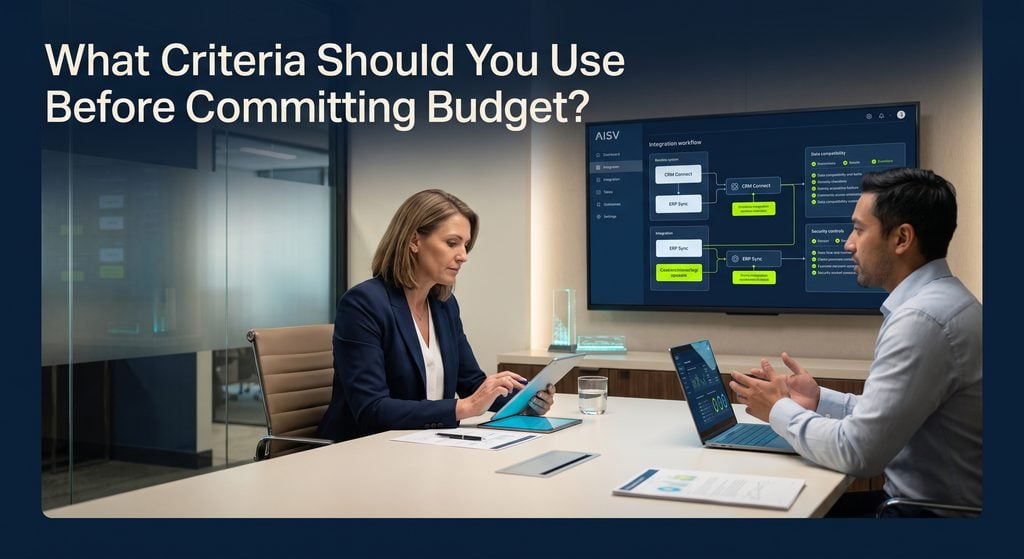
What Criteria Should You Use Before Committing Budget?
If you are asking, “What criteria should I use to evaluate AI tools and vendors before committing budget?” use this checklist. It will keep you grounded when the sales pitch gets flashy.
First, check integration compatibility. Can this tool connect to the systems you already use, like your CRM, ERP, project management platform, help desk, or internal database? If the answer is “not really” or “with a lot of custom work,” your real cost just went up.
Second, review data security and privacy in detail. Ask:
- Where does your data go?
- Is customer data used to train the vendor’s model?
- Can that be turned off?
- What access controls exist?
- What compliance standards do they support?
- How do they handle retention and deletion?
If you need help thinking through this side, read the owner-operator’s guide to AI vendor security and SOC 2 compliance. This is one area where “we take security seriously” is not enough.
Look at Total Cost, Not Just Subscription Price
The monthly fee is rarely the full number. You need to calculate Total Cost of Ownership.
That includes:
- Subscription or licensing fees
- Setup and integration work
- Internal project management time
- Team onboarding and training
- Ongoing maintenance
- Vendor support tiers
- Process redesign costs
A cheap tool with heavy setup and weak support can cost more than a pricier tool that works out of the box. This is one of the most common mistakes in AI vendor criteria reviews. Buyers compare subscription tiers and ignore the cost of making the tool usable.
Vet the Vendor, Not Just the Product
A strong demo does not automatically mean a strong partner. Look at the vendor’s track record with the same seriousness you would use for a key hire.
Ask for:
- Relevant case studies in your industry or business model
- Examples of measurable outcomes, not just feature lists
- Clear support expectations and response times
- References from customers with similar team size or complexity
- A realistic view of what adoption actually takes
And pay attention to how they talk. Do they focus on your workflows, your KPIs, and your constraints? Or do they stay stuck in technical specs? If you need a broader comparison process, this guide on how to compare and choose between AI investment options is worth reviewing.
Evaluate the Learning Curve Honestly
Finally, ask whether your team can actually adopt the tool. This is where many good-looking AI projects fail.
Look at:
- How intuitive the tool is for non-technical users
- Whether the vendor provides onboarding and upskilling
- How much manager oversight it will require
- Whether your team has time to learn it right now
- Whether success depends on behavior change you have not planned for
If adoption requires a level of bandwidth your team does not have, the tool is not ready for your business yet. That is not failure. That is good decision-making.
Red Flags: When to Say No to an AI Project or Vendor
What Are the Biggest AI Red Flags?
If you want to avoid bad spending, learn to spot AI red flags early. Most wrong-fit investments show warning signs before the contract is signed.
The first red flag is hype without process. If a vendor promises dramatic results but cannot explain exactly how those results happen, be careful. Words like “fully autonomous,” “revolutionary,” or “set it and forget it” should make you ask harder questions, not easier ones.
The second red flag is a solution looking for a problem. If the project sounds interesting but is not tied to a defined bottleneck, KPI, or business outcome, it is probably not worth funding.
Walk Away From Black Box Risk
You should also say no when the vendor operates like a black box.
That includes vendors who cannot clearly answer:
- How your data is handled
- What models are being used
- What controls exist for privacy and permissions
- What happens if outputs are wrong
- How human review fits into the workflow
- What compliance support exists for your industry
If they dodge basic governance questions, walk away. Responsible AI adoption requires transparency. This is especially true if you are handling customer data, financial information, HR records, or anything sensitive.
Notice Internal Red Flags Too
Sometimes the problem is not the vendor. It is readiness.
Pause the investment if:
- Your team has no time to adopt the tool
- No one owns implementation internally
- Leaders are unclear on the success metric
- Foundational AI literacy is still low
- Existing workflows are undocumented or chaotic
- You are trying to automate a broken process
This is where many businesses need to slow down before they speed up. If the internal groundwork is missing, the right move may be training, workflow cleanup, or advisory support first. This piece on AI implementation barriers and how to overcome them can help you assess that honestly.
Trust the Business Conversation
Here is a simple gut check: if the vendor talks mostly about models, features, and technical architecture, but very little about outcomes, adoption, and ROI, that is a problem.
Good partners ask questions like:
- What business problem are you solving?
- What does success look like in 90 days?
- Who will use this daily?
- What systems does this need to fit into?
- What risks matter most in your environment?
If they are not asking those questions, they are probably selling software, not helping you make a smart investment.
How Do You Know When to Say No?
You say no when any of these are true:
- The ROI case is weak or unclear
- The team cannot realistically adopt it now
- The vendor cannot explain security and governance clearly
- The tool does not solve a defined business problem
- The implementation burden is bigger than the likely gain
- The seller is pushing urgency harder than fit
Saying no is not anti-innovation. It is how disciplined companies protect capital for the right opportunities. If you want a second opinion before signing anything, this guide on how to hire and vet an AI consultant without getting burned is a smart companion read.
Turning Your AI Strategy Into Measurable ROI
The strongest AI investment framework is simple: align every investment to a real business goal, vet every tool and vendor rigorously, and be willing to walk away when the fit is wrong. That is how owner-operators stop reacting to hype and start making confident, measurable decisions.
Real AI ROI for business comes from three things working together: the right plan, the right tools, and the right team capability. Miss one of those, and even a promising investment can stall. Get all three right, and AI becomes a real operating advantage instead of an expensive experiment.
If you are ready to make smarter AI decisions, AI Smart Ventures can help. Through AI consulting and ongoing advisory, the team helps businesses identify the best-fit opportunities, pressure test vendor decisions, and build practical roadmaps tied to real outcomes. Ready to Transform Your Business with AI? Book a tailored consultation with AI Smart Ventures to identify your best AI opportunities and map the fastest path to real ROI.