What Should AI Cut When Rewriting for a New Audience?
Last Updated: October 2026
An AI rewrite for an audience is the job of taking a report you already have and making it fit a reader it was never written for. A technical report sent to a client who is not technical. An in-house paper sent to a board. A long bid cut down for somebody who will skim it. The work is mostly cutting, and cutting is what AI does worst.
AI Smart Ventures has guided growing businesses through AI adoption in reporting, client work and board papers. The same ask comes up in every room: make this shorter for somebody else. What comes back is the same report in smaller words, with every section still standing.
That costs you the meeting. A reader who has to hunt for the ask will guess at it, or send the paper back with questions you answered on page nine. The worst case is quiet: the new draft reads well and drops the condition that made your advice right.
Key Takeaways
- Name what the reader will do with it: decide, approve, act or file, because the verb decides which half of the paper is dead weight.
- AI pads when you ask it to cut: YapBench, posted on 2 January 2026, scored 76 assistant models on 300 prompts where a short answer was ideal, and found a tenfold spread in median excess length.
- Plain writing on hard subjects now has a standard: ISO 24495-3:2026, published in May 2026, covers science writing for readers of every schooling level, from students to the people who decide.
- Three things survive every cut: the ask, the caveat that would change the answer, and the number the reader will quote.
Read the second item against the first and the problem comes clear. A tool told to shorten a file holds no view on what that file is for, so it trims evenly and keeps the shape, not the point.
What should AI cut when the reader changes?
Cut whatever existed to serve the old reader. In most business papers that is four things: the method, the story of how the work got done, the defense of choices nobody new will question, and the hedging that protected the writer, not the reader. None of it is wrong. It was written for people who needed the working; your new reader needs the finding.
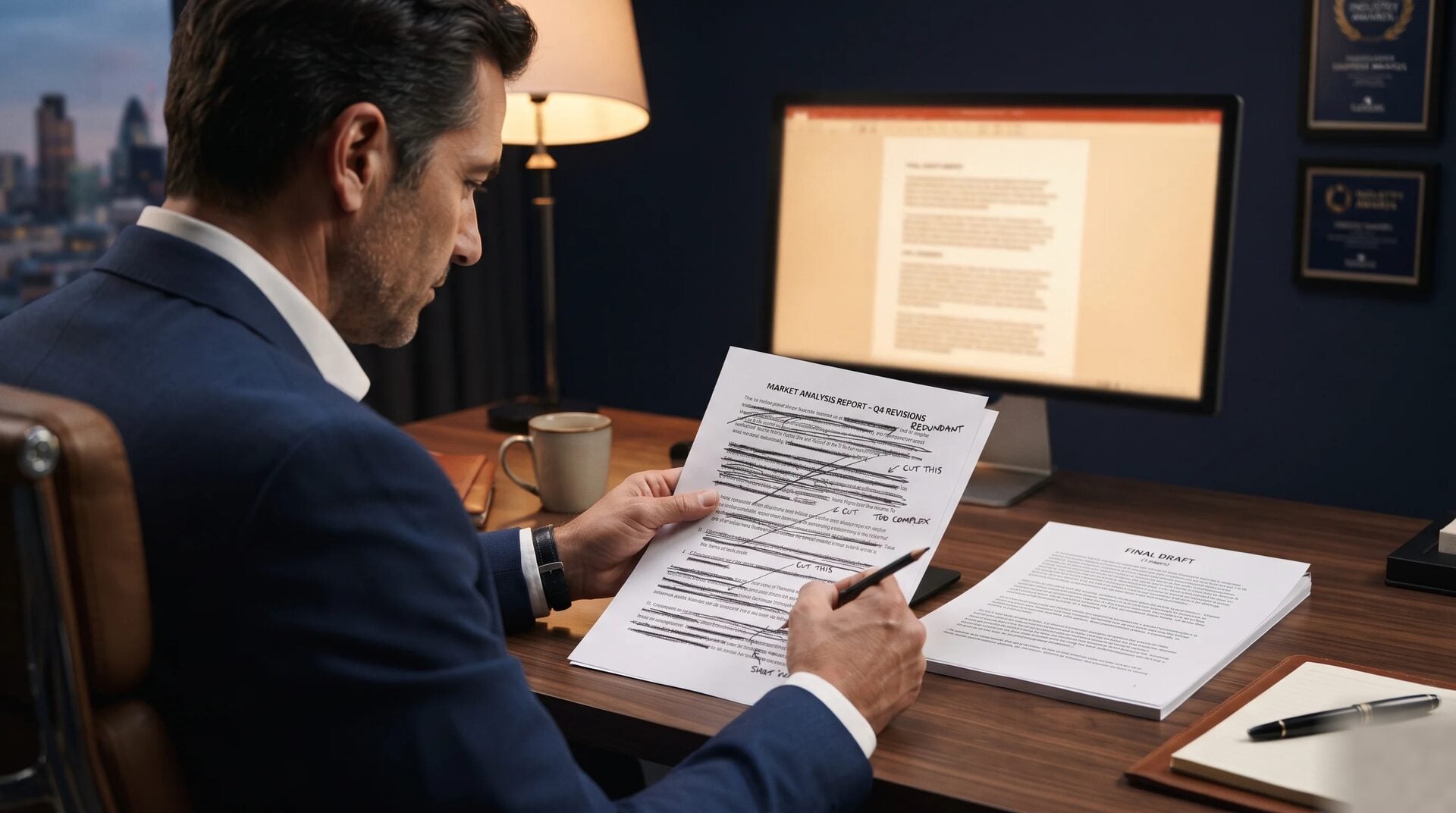
Mark what stays rather than what goes, because a cut list grows all afternoon and a keep list does not. Read your own paper as the new reader, then strike any block that cannot change what they do next. That test is harsh on background sections, which is correct. A client does not need your sampling method; they need to know whether the finding holds. Practical AI here is a shorter page, not faster typing.
- The method: who you asked and what you held steady, all bound for the back pages.
- The back story: the routes your team tried first, which matter in house and nowhere else.
- The hedging: words added to cover the writer, not to warn the reader.
- The repeated setup: anything this reader knows better than you.
Why does AI keep too much when you say simplify?
Because “simplify this” is an order about words, and the job is a choice about purpose. Told to make a paper plainer, a tool swaps long words for short ones and keeps every section, since dropping one looks like losing facts. YapBench, posted on 2 January 2026, scored 76 assistant models on 300 prompts where a brief answer was ideal, measuring how far each reply ran past a bare baseline.

The result is mush: shorter sentences, the same length, nothing decided, and readers notice. Templafy’s Business-Ready AI Gap report, from 2,000 US and UK knowledge workers polled in August 2026, found 95% edit AI output before it can be used, and 34% named generic phrasing as what they fix. Those workers lose close to four hours a week checking and fixing AI drafts. Working out what the reader does not need is the part you cannot hand over.
What must never be cut from the document?
Three things, plus a date. The ask comes first: what you want the reader to do, written as an action with a name on it. Then the caveat that would change their answer, which sits beside the finding and never in a footnote. Then the number they will quote in their own meeting, with units and period. Last, the date the choice closes, because a paper with no deadline gets filed.
The caveat is the one that goes missing, and it goes quietly. Conditions sit next to findings in the first draft because the writer knew them. Cut the sentence carrying the condition and the finding stands alone, louder and wrong. “Renewals rose in two regions” asks for a different call than “renewals rose in two regions where we also changed the delivery promise”. AI Smart Ventures observes that the condition is nearly always known to the writer and nearly never on the page by the time a second reader sees it.
| Part of the first draft | Where it goes |
|---|---|
| The ask | First screen, with a name and a date |
| The caveat on the headline finding | Beside that finding |
| The number the reader will quote | Kept, with units |
| Method, sample and working | Back pages, one link away |
| Routes your team rejected | Cut |
What does the new reader have to do next?
Pick the verb before you touch the text: decide, approve, act, or file. A reader who decides needs the live options and the trade-off between them. A reader who approves needs the risk, the owner and the sign-off line. A reader who acts needs the steps and the date. A reader who files needs the record and nothing else. Write the verb down, then cut against it.
This is narrower than drafting a fresh summary for a leader, where you name the decision and let a tool work from the raw data. Here the paper already exists, somebody approved it for its first reader, and your job is to move it without breaking it. So the verb does double duty: it tells you what to keep, and what the second reader will blame you for leaving out. Written in one line, it is the piece of AI literacy that travels between jobs.
- Decide: give the live options, what each one gives up, and the point where you cannot go back.
- Approve: give the risk, the owner, and the line the signature goes on.
- Act: give the steps in order, the date, and who to ask when one fails.
- File: give the record, the dates and the reference, then strip out the argument.
AI Training builds this judgment into the people who send papers out, with AI upskilling on the keep list instead of another tool tour.
How do you check the rewrite still says the same?
Read the two drafts against each other on four points: the ask, the caveats, the numbers, and anything the new one states that the first never did. That last point is where AI adds rather than cuts. Faithful by Design, posted on 10 July 2026, built 1,800 model-written trial summaries for three sets of readers and found unsupported claims the biggest fault in every model tested.
A reading score is not that check, and it never was. A July 2026 revision of an eye-tracking study of reading-ease scoring tested reading formulas, newer model-based scorers and commercial reading systems against how fast adults really read, and found all of them predict English reading ease poorly. A grade level tells you the sentences got shorter, and only a person holding both drafts can say the meaning held. Generic AI consultants sell the pass; the check is the part worth keeping.
Frequently Asked Questions
How do you reword a document for a different reader?
Start with the reader’s job, not the text. Write one line naming who reads it now and what they must do, then mark the parts of the first draft that serve that line. Paste the file and the line together, and ask for a version keeping only what this reader needs before they can act. Read the result beside the first draft. Rewording sentences is the last step, never the first.
Which tool handles a rewrite for a new audience best?
Whichever one can see the whole file and your own house rules. A general assistant such as ChatGPT, Claude or Gemini handles a report you paste in full, provided you give it the reader and the verb. A tool wired into your own files does better on house style and agreed wording. Tool choice matters far less than the keep list.
Can you rewrite a document for free with AI?
Yes. Every major assistant has a free tier that will rewrite a paper you paste in, and that tier is enough for a one-off report. The limits you meet are length caps, slower replies at busy times, and no link to your own files. Check the data terms before pasting anything a client owns. The real spend is your own hour on the check.
What should you never let AI shorten?
The ask, the caveat on the headline finding, and any number with a condition on it. Those three carry the choice, and a shortening pass drops conditions first because they read as hedging. Guard quoted wording from a contract or a regulator too, since a tidier reword of a binding sentence is a new sentence. Everything else is open to the cut.
How much shorter should the new version be?
Short enough that the reader meets the ask on the first screen, which tends to mean a third to a half of the first draft for a client version, and less again for a board paper. Length is an outcome, not a target. Set a word count first and the tool trims evenly, leaving the ask buried. Cut by purpose, then measure.
Does cutting detail make the document less honest?
No, so long as the cut material stays reachable and the conditions travel with the findings. Moving your method to the back pages is normal practice; dropping the caveat that qualifies a result is not. Name the fuller version and where it lives, so a reader who wants the working gets there in one step. Honesty sits beside each claim, not in the page count.
Who signs off on a document rewritten for a client?
The person whose name was on the first draft, plus whoever owns the relationship. The writer checks that nothing changed meaning, and the account owner checks the ask matches what the client agreed to. Add a legal read where the text touches contract terms, data handling or anything a regulator sees. One named reviewer per version is enough, and change management is keeping that name in view.
What if the new reader knows more than the first one?
Then you cut the other way. The definitions, the analogies and the setup go, and the detail stays. Writing down to an expert costs you trust inside a paragraph. Keep the method, the sample and the limits, because an expert reads those first. Say in your brief that the reader works in the field, or the tool will add a primer nobody wanted.
How many readers can one document serve?
Two at most, and only where the second one reads a clearly marked section. Past that you are writing two papers and pretending otherwise. Tailoring does help: ReLay, a study of 50 lay readers across 300 summary pairs revised in September 2026, found tailored versions improved understanding while raising the risk of invented detail. Split the paper rather than blending the readers.
How do we get our team rewriting documents this way?
Less setup than most people expect: one worked example, one keep list, and a named reviewer. Pick the paper your business sends out most often, write the reader and the verb at the top, and run it once. Scope is one file and one hour, with no new software. Schedule a consultation with AI Smart Ventures to set the keep list for the papers clients really read.
Executive Summary
Rewriting a report for a new audience is mostly cutting, and AI defaults to keeping everything. The brief that works is not “simplify this” but a line naming who reads it now and what they must do: decide, approve, act or file. That verb decides what goes, usually the method, the back story and the hedging. Three things never go: the ask, the caveat that would change the answer, and the number the reader will quote. Read both drafts side by side afterward, because a reading score only tells you the sentences got shorter.
What Should You Do Next?
This week, take the last report you sent outside your team and write two lines at the top: who reads it now, and what they must do with it. Mark every block that cannot change that action, and cut those first. Run the rest through a tool, then read both drafts side by side on the ask, the caveats and the numbers.
AI Smart Ventures offers AI Training for growing businesses whose teams send papers to clients, boards and partners, with capability building around the keep list and the check. Schedule a consultation to set a rewriting standard your readers will act on.
People Also Read
- AI Bookkeeping Tools for Independent CPA Firms in 2026
- AI Tool Hopping: The Hidden Cost of Switching Stacks Too Often
About the Author
Nicole A. Donnelly is the Founder of AI Smart Ventures and an AI Adoption Specialist with 20 years of experience as a founder and CEO and over a decade leading AI adoption initiatives. She helps businesses integrate artificial intelligence with clarity and confidence, driving innovation and sustainable growth. Nicole has trained over 20,217 professionals in Applied AI, delivered 624 workshops, and worked with close to 1,000 organizations across diverse industries.
Expertise: AI Transformation, AI Strategy, AI Implementation, AI Adoption, Applied AI, Marketing, Business Operations
Disclaimer: This content is for informational purposes only and does not constitute professional business or technology advice. Results vary based on industry, existing systems and implementation commitment. Contact AI Smart Ventures for a consultation regarding your specific situation.