AI Training for Your Business Team: Choosing Between Off-the-Shelf Courses, Live Workshops, and Custom Programs
AI Training for Your Business Team: Navigating Courses, Workshops, and Custom Programs
If you are trying to build AI capability inside your company right now, the hardest part usually is not choosing a tool. It is choosing how your team should learn. There are pre-made courses, self-paced labs, live cohort AI training, custom AI workshop options, and fully tailored programs that promise transformation. That is a lot to sort through, especially when you are also trying to protect time, budget, and momentum.
Here is the simple truth: the best AI team training format depends on the team, the workflow, and the business outcome you need. A founder, an ops lead, and a marketing director may all need AI training, but they should not all get the same program. At AI Smart Ventures, we see this every day. Training works when it changes how people do real work, not when it just gives them more theory to sit on.
In this guide, we will walk through the core choices. We will compare pre-made courses with custom team training, self-paced AI labs with live cohorts, and prompt engineering courses with hands-on workshops for marketing teams. We will also cover the signs that an AI training program will actually drive workflow change and measurable AI business ROI.
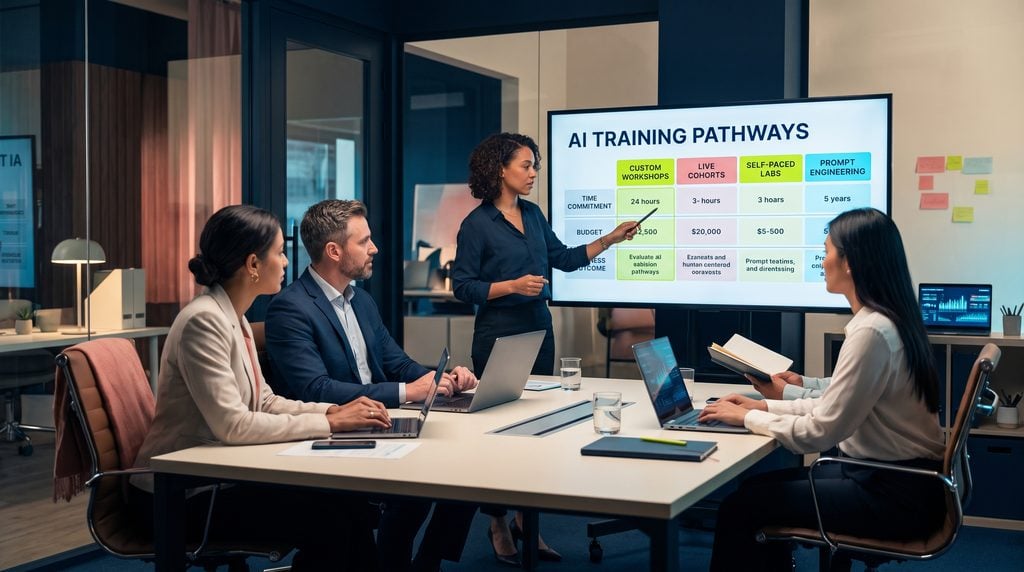
The Foundation: Pre-Made AI Courses vs. Custom Team Training
Does it make more sense to buy a pre-made AI course or hire someone for custom team training? For most businesses, the answer is: start with the outcome you need. If you need broad AI literacy across roles, a pre-made course is usually the smartest first move. If you need your team using AI inside your actual systems and workflows fast, custom training usually wins.
When a Pre-Made AI Course Makes Sense
Off-the-shelf training works best when your goal is foundational capability. Think baseline prompt engineering, tool familiarity, and helping people stop staring at AI from the sidelines.
A pre-made course is usually the right fit when:
- Your team is early in its AI journey
- You need consistent training across many employees
- You want a lower-cost way to build shared vocabulary
- Individuals need to upskill at their own pace
- You want a strong starting point before deeper implementation
When Custom Team Training Makes Sense
Custom training is the better choice when generic examples are not enough. If your team needs to work with your internal processes, your software stack, your compliance rules, and your business goals, custom beats generic almost every time.
Custom AI workshop and training programs are ideal when:
- Teams need to use AI with proprietary workflows or data
- You want output during training, not just knowledge after training
- Departments have different use cases and bottlenecks
- Leadership needs training tied to strategic KPIs
- Adoption has already stalled and needs a reset
A generic course can teach prompting. A custom program can teach your sales team how to use prompting inside account research, your HR team how to draft policy updates, and your operations team how to map automation opportunities in the systems they already use.
Cost, Scale, and ROI
Here is the practical tradeoff. Pre-made training is cheaper upfront. Custom training often creates faster ROI because it is built around the exact work your team does every day. Many companies do best with a hybrid model: start with a shared foundation, then layer in tailored support for teams that need deeper application.
If you want a broader framework for that, our guide on how owner-operated businesses can design a generative AI training program that drives results is a strong next read.
Optimizing Operations: Self-Paced AI Labs vs. Live Cohort Training
How do you choose between self-paced AI labs and live cohort-based training for your ops team? Choose self-paced when you need flexibility for capable, self-directed learners. Choose live cohort AI training when you need adoption, standardization, and real process change across a team.
Operations teams are a special case because they do not just need tool knowledge. They need workflow integration. They need to map repetitive work, spot automation opportunities, and build systems that hold up under real business pressure.
The Case for Self-Paced AI Labs
Self-paced labs work well for operations leaders who are already comfortable experimenting and do not need much hand-holding. They offer flexibility for busy schedules, lower disruption to daily operations, and are good for independent learners and targeted skill building. However, they tend to have lower completion rates, less accountability, and teams can learn in silos instead of building a shared process.
Why Live Cohorts Often Work Better for Ops
For most ops teams, live cohorts create better results. Operations work is interconnected — one person changing a process affects everyone else. Live training gives teams a place to map that together. Live cohorts are especially strong when you need shared process design, real-time troubleshooting, cross-functional alignment, and faster movement from idea to implementation.
If training alone has not created traction, it may help to look at AI enablement for teams and how it differs from training and employee AI adoption when training alone is not working.
Empowering Marketing: The Fastest Paths to Upskill Non-Technical Teams
What is the fastest way to upskill a non-technical marketing team on AI? Hands-on training tied directly to current marketing tasks is the fastest path. Marketers learn AI fastest when they use it to build real briefs, campaigns, content, and reporting workflows during the training itself.
Which is better for a marketing team — an AI prompt engineering course or a custom AI workshop? If your marketers need fundamentals, start with a prompt engineering course. If they need immediate output and adoption, a custom AI workshop is usually the better investment.
Where an AI Prompt Engineering Course Helps
A prompt engineering course teaches the mechanics of working with LLMs. Teams need to know how to give clear instructions, iterate on outputs, and move from vague prompts to reliable results. It is useful when your marketing team needs to understand how prompting works, build confidence with AI tools, and create a shared baseline before department-specific training — especially when people are still asking basic questions like “What do I even type?”
Why Custom Workshops Often Win for Marketing Teams
Marketing teams usually care less about abstract AI knowledge and more about execution speed. In a good custom workshop, your team is not just learning prompting in theory. They are building campaign messaging in your brand voice, drafting SEO briefs and content workflows, creating reusable prompt libraries, and testing AI against approval and review processes. For non-technical marketers, this reduces fear fast. AI stops feeling like a mysterious tool and starts feeling like a useful assistant.
The Fastest Route for Non-Technical Marketers
If speed is the goal, here is the most practical sequence: teach the basics of prompting and safe AI use, move quickly into team-specific use cases, build assets during the session, save prompts and templates for reuse, then follow up with support so the habits stick. That is how you upskill marketing team AI capability without overwhelming people.
For a deeper playbook, read how to train your marketing team on generative AI and how to train your entire team to use generative AI safely.
Measuring Impact: Signs Your AI Training Will Actually Drive Change
What signs show that an AI training program will actually change how your team works? The biggest sign is simple: the training is tied to real workflows, real outputs, and real KPIs. If it is mostly theory, it probably will not stick.
Red Flags to Watch For
Be careful if a program spends most of its time on AI history and trend talk, tool demos without hands-on use, generic examples that do not match your business, no discussion of governance or safe use, or no support after the session ends. That kind of training can feel exciting in the room and disappear by Monday.
Green Flags That Point to Real Change
The strongest AI team training programs include hands-on work during the session, prompts and templates people can reuse immediately, workflow mapping tied to actual roles, clear before-and-after success measures, leadership participation and follow-through, and post-training support or community.
This is also where practitioner-led training matters. Teams trust training more when the people teaching it have actually used AI in real business environments. If that matters to you, read why your business needs practitioner-led AI guidance.
How to Track ROI After Training
You do not need complicated measurement to know if training is working. Start with a few operational metrics: hours saved on repetitive tasks, increase in content output, faster turnaround times on drafts or reports, reduction in ops bottlenecks, improvement in lead quality or campaign velocity, and adoption rate across the team.
Training sticks when leadership makes room for it. If managers expect the same workload but add AI experimentation on top, adoption slows down. If leaders encourage testing, share wins, and normalize iteration, teams move much faster. Our article on why employees are resistant to AI and what to do about it goes deeper on that point.
Next Steps: Building Your Organization’s AI Training Roadmap
The right training choice is not really about courses versus workshops versus custom programs in the abstract. It is about fit. Foundational courses are great for broad literacy. Live cohorts are powerful when a team needs shared momentum. Custom programs are usually the fastest path when the goal is workflow change and measurable ROI.
The best next step is to audit where your team is losing time right now. Look at repeated tasks, blank-page work, reporting bottlenecks, content production slowdowns, and process handoffs. That is where AI training becomes useful fast. From there, you can match the format to the need instead of buying training that sounds impressive but never changes behavior.
AI training is not a one-time event. It is part of a larger capability-building process. Ready to transform your business with AI? Book a tailored consultation with AI Smart Ventures to identify your best AI opportunities and the fastest path to real results. Or, get started immediately with our Applied AI Course Level 1.