How Owner-Operators Can Choose an AI Investment Advisor Who Delivers Measurable Returns: A Practical Vetting Guide for 2026
If you are an owner-operator trying to choose an AI investment advisor in 2026, start here: the right advisor should help you make fewer bets, not more. They should tie AI decisions to measurable returns, operational capacity, team adoption, and risk control. If they lead with tools before business goals, or hype before KPIs, keep looking.
Key Takeaways
- The best AI investment advisor helps you prioritize business outcomes, not chase every new tool.
- Specialized B2B AI consultants are usually a better fit than broad transformation firms for non-technical owner-operators.
- The most useful AI consulting services for non-technical business owners are AI advisory, roadmap creation, implementation planning, and team upskilling.
- Strong AI strategy starts with business capacity: budget, team readiness, workflow maturity, and leadership buy-in.
- If an advisor cannot define success in measurable terms like time saved, cost reduced, revenue increased, or risk lowered, the investment is not ready.
- A good vetting process protects your returns by checking delivery method, security posture, training plan, and ongoing support.
- AI should reduce friction in your business, not add technical debt, tool sprawl, or compliance risk.
The State of AI Investments for Owner-Operators in 2026
Owner-operators are under real pressure in 2026. You can feel it from every direction. Competitors are talking about automation. Vendors are promising instant efficiency. Your team is experimenting with tools on the side. And somewhere in the middle of all that noise, you are still trying to run the business. That is exactly why vetting matters.
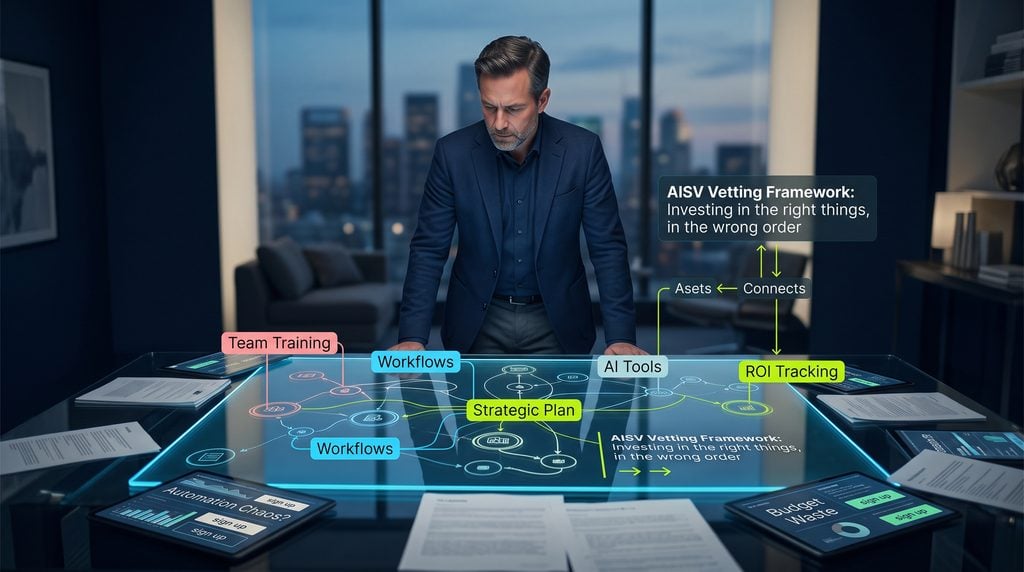
The risk is not that you ignore AI. The risk is that you invest in the wrong things, in the wrong order, with the wrong expectations. That is how shiny object syndrome turns into budget waste. One new tool becomes five. One pilot becomes a pile of subscriptions. And six months later, you have activity but no measurable returns.
So what is an AI investment advisor now? In practical terms, it is a partner who helps you decide where AI should and should not go in your business. A strong advisor does more than recommend software. They connect strategy, tools, workflows, and team training so your investment has a real shot at producing results. For non-technical business owners, that matters a lot. AI success rarely comes from tools alone. It comes from a clear plan, the right implementation path, and a team that can actually use what gets built.
The Consulting Landscape: Specialized B2B AI Consultants vs. General Transformation Agencies
B2B AI Consultants vs General Digital Transformation Agencies: Which Is Better?
For most owner-operators, specialized B2B AI consultants are the better choice. That is especially true if you want fast clarity, practical execution, and a partner who can explain things in plain business language.
General digital transformation agencies often do broad work across software, systems, process redesign, and enterprise change. Some are excellent. But many approach AI as one line item inside a much larger modernization pitch. That can lead to oversized scopes, long timelines, and generic recommendations that do not match the pace or capacity of a growing business.
Specialized AI firms work differently. They tend to focus on live workflows, real use cases, and measurable business outcomes. Instead of asking, “How do we transform the whole organization?” they ask, “Where can AI save time, reduce cost-to-serve, improve output quality, or unlock revenue in the next 90 to 180 days?” That is a much better starting point for owner-operators.
Which AI Consulting Services Are Best for Non-Technical Business Owners?
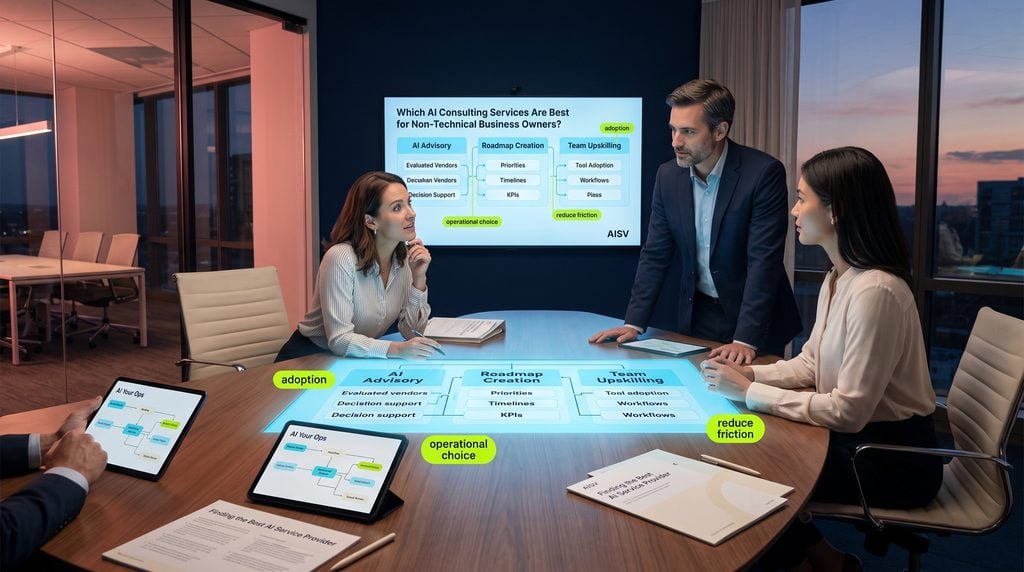
The best AI consulting services for non-technical business owners usually fall into three buckets:
- AI Advisory for ongoing guidance, vendor evaluation, and decision support
- Roadmap Creation for defining priorities, owners, timelines, and KPIs
- Team Upskilling so employees can actually adopt the tools and workflows
That combination works because it closes the biggest gap in most AI projects: adoption. A strategy without training stalls. Training without strategy creates random experimentation. And tools without advisory support often lead to expensive confusion.
This is where specialist firms stand out. They bridge the technical gap by translating complex AI decisions into operational choices. They do not expect you to become an engineer. They help you understand what matters, what does not, what can wait, and what will likely move the needle now. If you want a deeper look at what that should feel like, this guide on AI for non-technical people is a useful companion read.
A good example is a framework-led offer like AI Your Ops. That kind of program is far more useful to many owner-operators than a vague transformation retainer because it starts with workflow mapping. It looks at where time is actually going, where manual work is piling up, and where AI can reduce friction without blowing up the way your team already works. That is a much smarter entry point than a generic software overhaul.
And if you are still comparing options, it helps to review both strategy and execution together. Articles like Finding the best AI service provider and How do you know if your AI consultant is qualified? can help sharpen your shortlist.
Aligning Strategy with Capacity to Ensure Clear Value
Which AI Consultants Are Best at Aligning AI Strategies With Business Capacity?
The best AI consultants do not start with the tool. They start with your business capacity.
In this context, capacity means a few very practical things: how much budget you can commit, how much change your team can absorb, how mature your workflows are, how much leadership attention is available, and how quickly you need results. If an advisor ignores those realities, even a smart AI idea can become a bad investment.
Top firms know this. They assess operational bandwidth before they recommend technical solutions. They want to know whether your team can support a pilot, whether your data is usable, whether your managers can reinforce adoption, and whether the workflow itself is stable enough to automate. This is one reason specialized firms often outperform broad agencies. They understand that AI strategy alignment is not just about ambition. It is about fit.
Top Firms for Ensuring AI Investments Actually Make Sense and Show Clear Value
The top firms for ensuring AI investments actually make sense and show clear value usually share a few traits:
- They create clear roadmaps instead of open-ended development contracts
- They sequence investments rather than pushing everything at once
- They define business KPIs before implementation starts
- They connect technology choices to workflow realities
- They build adoption and training into the plan from day one
That roadmap piece matters more than most owners realize. A real roadmap should tell you what to do first, what to delay, who owns each step, what success looks like, and how results will be measured. If you are getting a giant deck full of possibilities but no funded path forward, you do not have a strategy yet.
Measurable KPIs are the other big signal. Your AI investment advisor should be comfortable talking in terms like: hours saved per week, reduction in manual rework, faster turnaround time, lower support costs, increased lead volume or conversion, better forecast accuracy, and reduced compliance or quality risk.
That is how AI investments actually make sense. Not because the tech is exciting, but because the business case is clear. If you want a stronger framework for that conversation, AI investment accountability and AI time-to-value are worth reviewing.
When strategy is aligned with capacity, adoption gets easier too. People are not being asked to change everything at once. They are being asked to use AI where it obviously helps. That is how you move from curiosity to real results.
The Vetting Checklist: How to Protect Your Business Returns
How Do I Choose an AI Investment Advisor Who Will Protect My Business Returns?
If your goal is to protect returns, do not start by asking which tool stack they like. Start by asking how they de-risk decisions.
A good AI investment advisor should be able to explain how they evaluate use cases, how they test assumptions, and how they prevent businesses from overspending on low-value experiments. They should also have a clear point of view on secure integration, data handling, and compliance. If they wave away risk with “we’ll figure it out later,” that is your answer.
Here is a practical vetting checklist you can use in real conversations:
- Ask how they define measurable returns. What KPIs do they use most often?
- Ask how they assess business capacity. Do they evaluate team readiness, workflow maturity, and budget before making recommendations?
- Ask for case studies or delivery frameworks. Can they show how they move from strategy to implementation to adoption?
- Ask what happens after kickoff. Do they provide ongoing support, or do they disappear after the roadmap?
- Ask how they handle security and privacy. What is their approach to sensitive data, access controls, and compliance?
- Ask how they train your team. Is upskilling built into the engagement, or treated like an optional add-on?
- Ask whether they begin with a tailored consultation. Or are they trying to force-fit you into a pre-packaged offer?
That last point is important. The right advisor should begin with your workflows, not their product menu. They should want to understand where value is most likely before they recommend a solution. If you need a stronger owner-side framework for comparison, How to hire and vet an AI consultant without getting burned is a helpful next read.
You should also look closely at whether the advisor includes training and change support. This is where many AI projects quietly fail. The tool works, but the team never really adopts it. Strong partners build in AI training, clear workflows, and reinforcement so the value sticks.
Finally, do not ignore governance. Owner-operators often think compliance is only an enterprise issue. It is not. If your business handles customer data, financial data, HR data, or proprietary information, governance matters now. Pieces like How do you manage AI risk when you don’t have a legal team? and The owner-operator’s guide to AI vendor security and SOC 2 compliance can help you ask better questions before you sign anything.
Next Steps: Building Your Practical AI Roadmap
The right AI investment advisor should make your business clearer, not more complicated. They should help you align AI with real business goals, real team capacity, and real measurable returns. That means less app sprawl, fewer random experiments, and a much better shot at getting value from every dollar you invest.
So before you buy another tool, step back and assess your workflows. Where is time being lost? Where is manual work piling up? Where would faster decisions, better consistency, or lower cost-to-serve create the biggest win? That is where your roadmap should start.
Ready to transform your business with AI? Book a tailored consultation with AI Smart Ventures to identify your best AI opportunities and build a practical roadmap for real results.